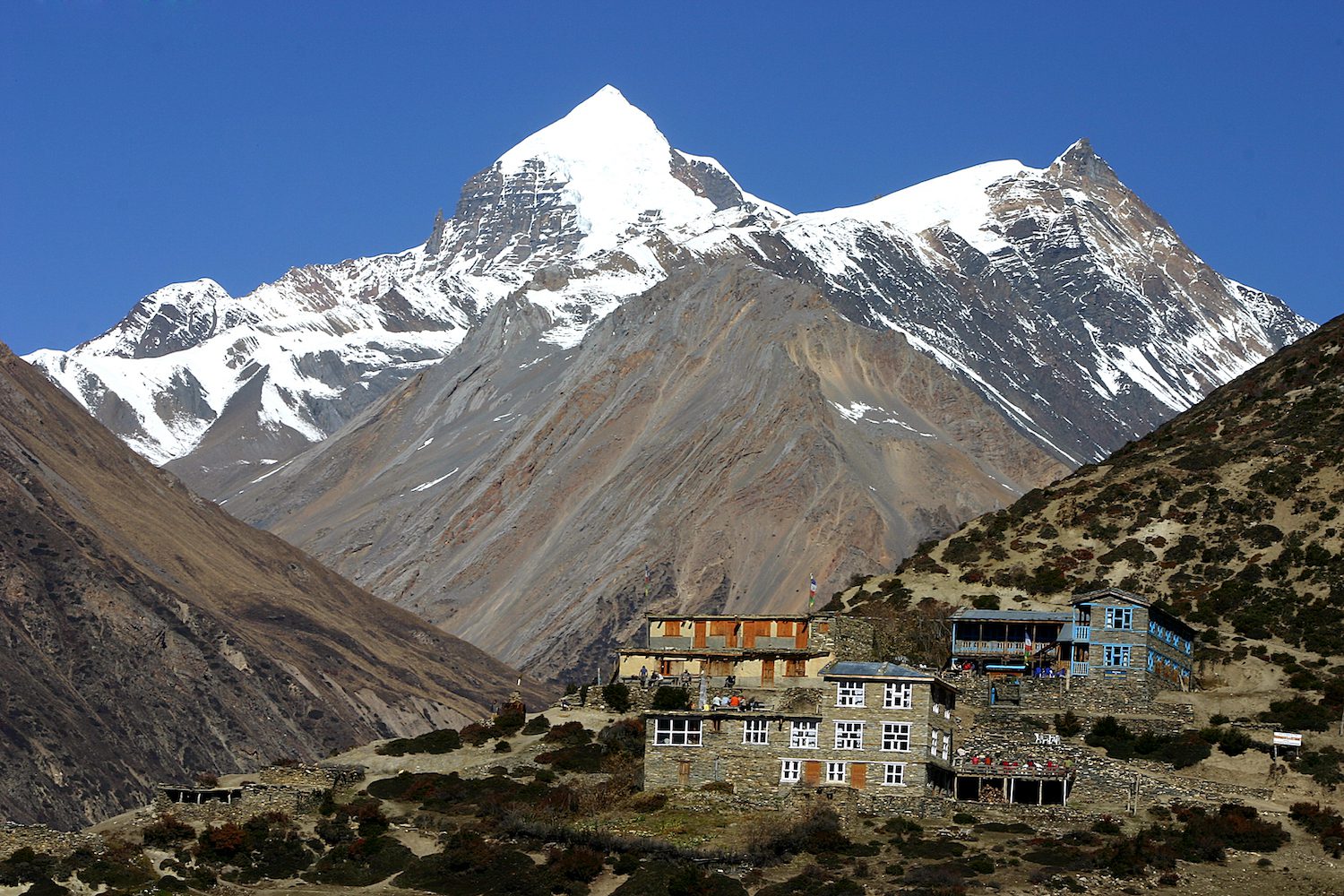
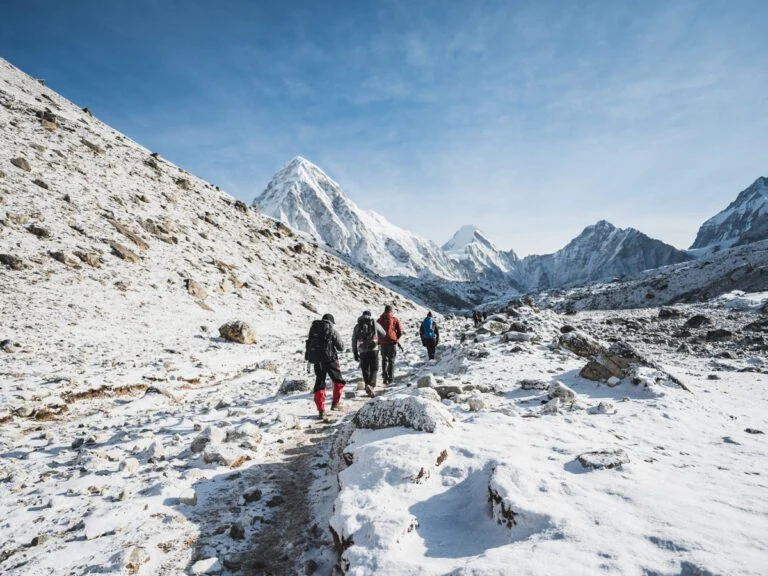
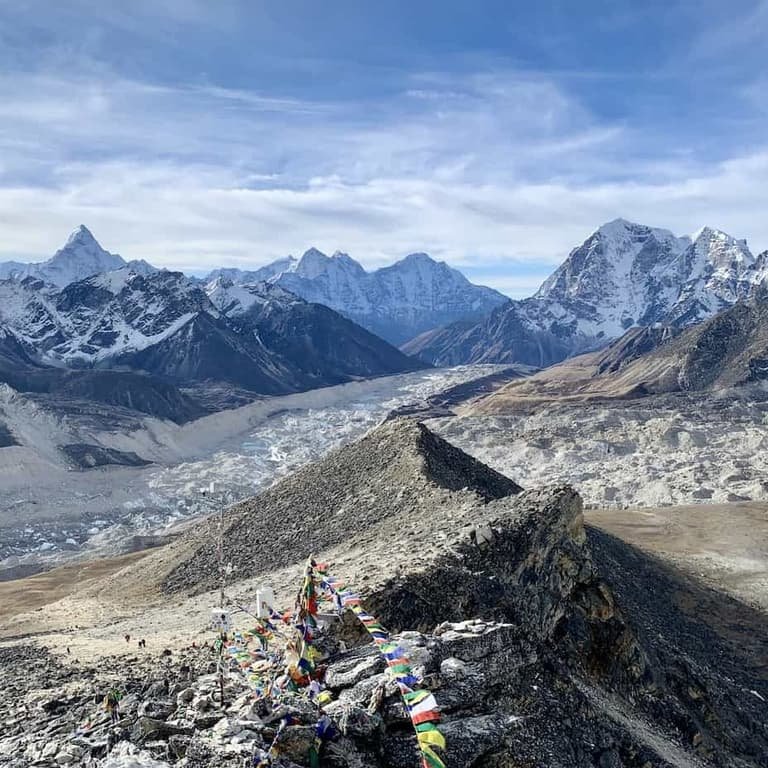
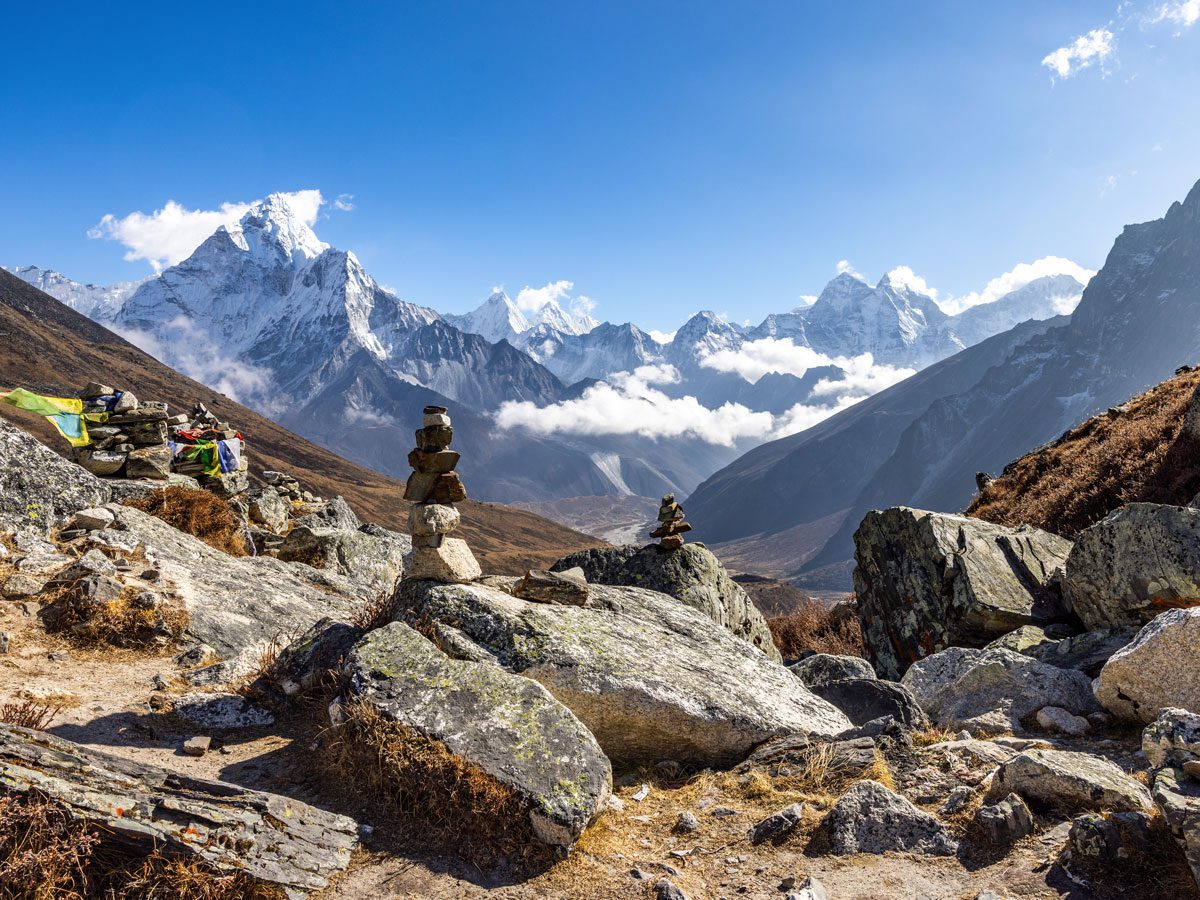
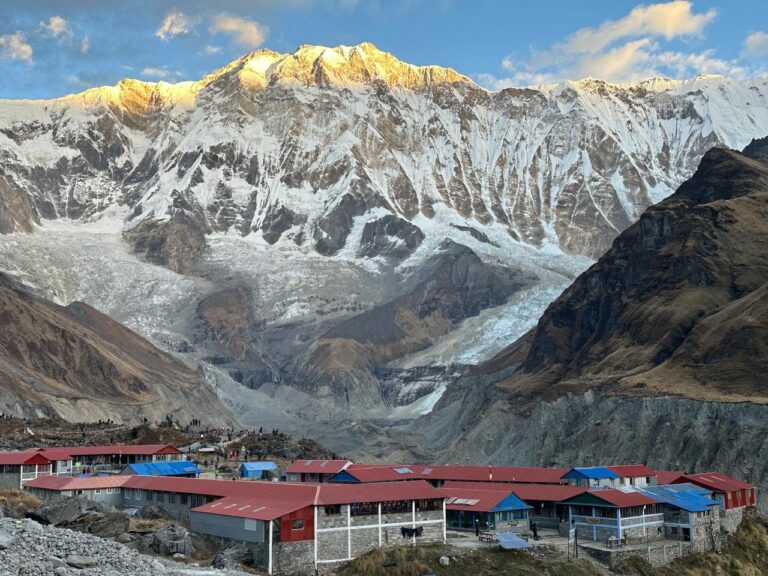
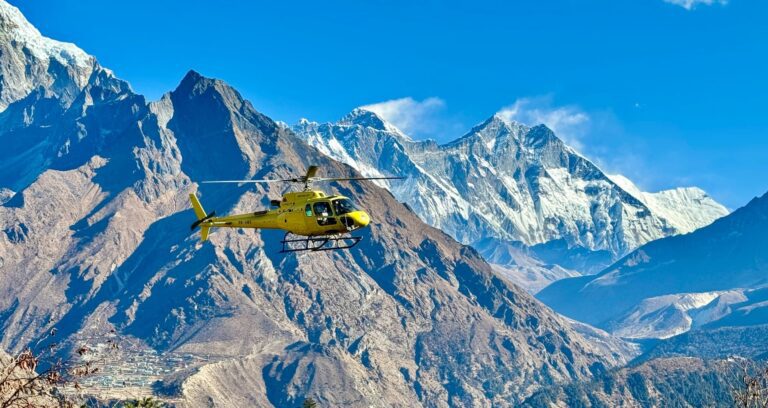
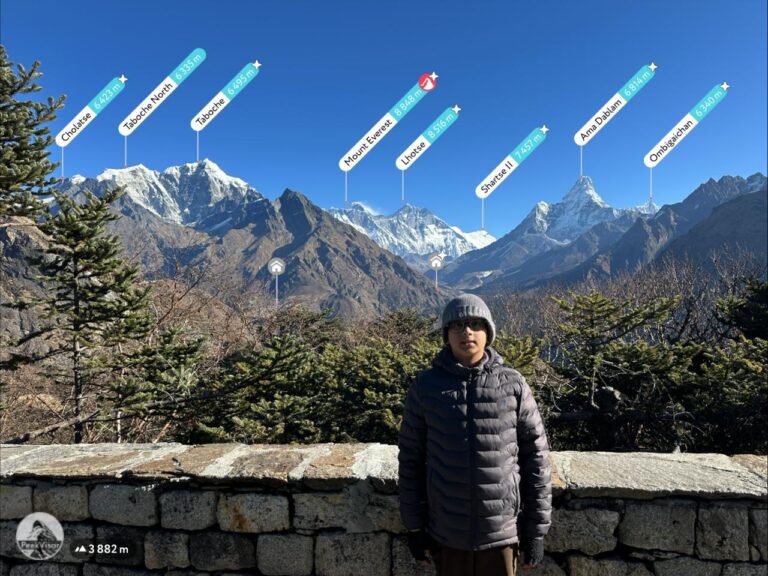
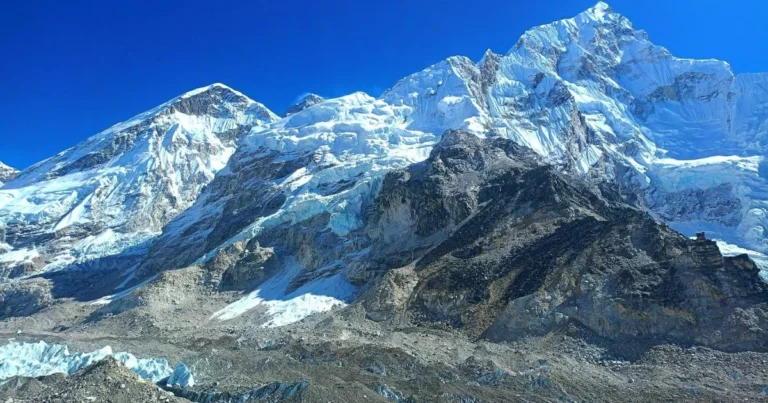
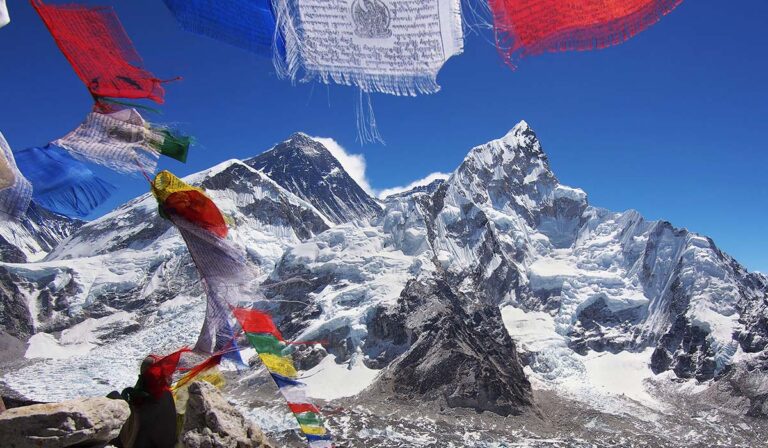
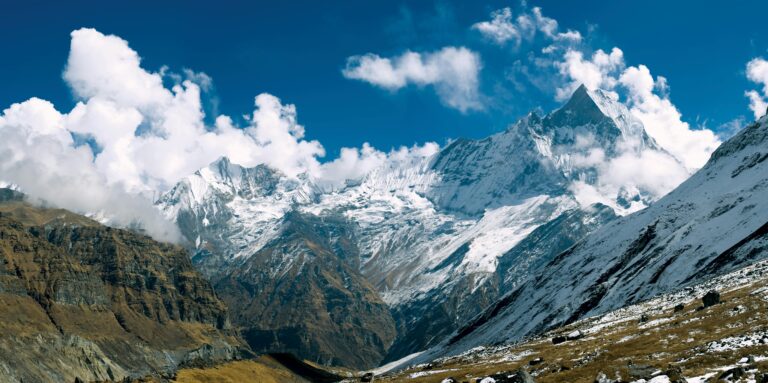
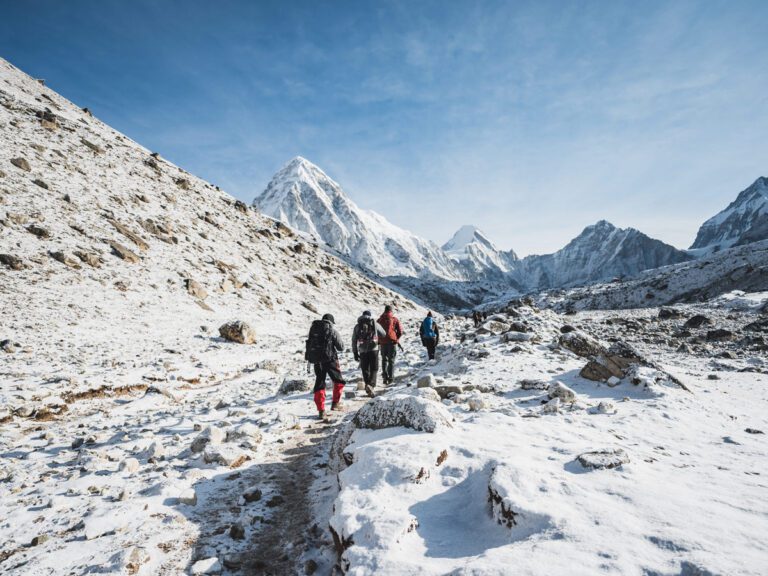
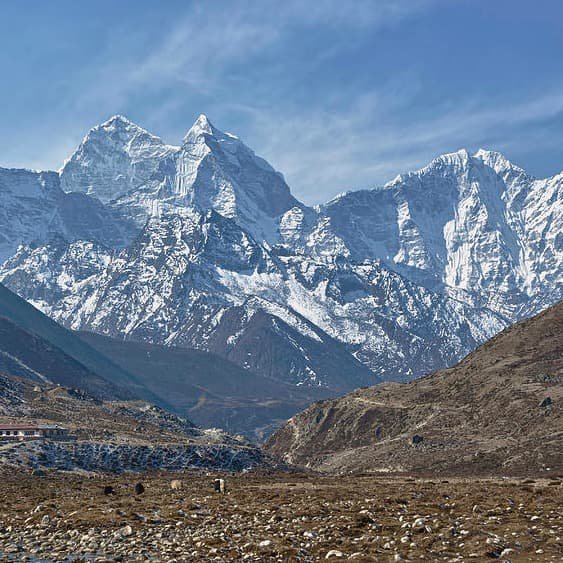
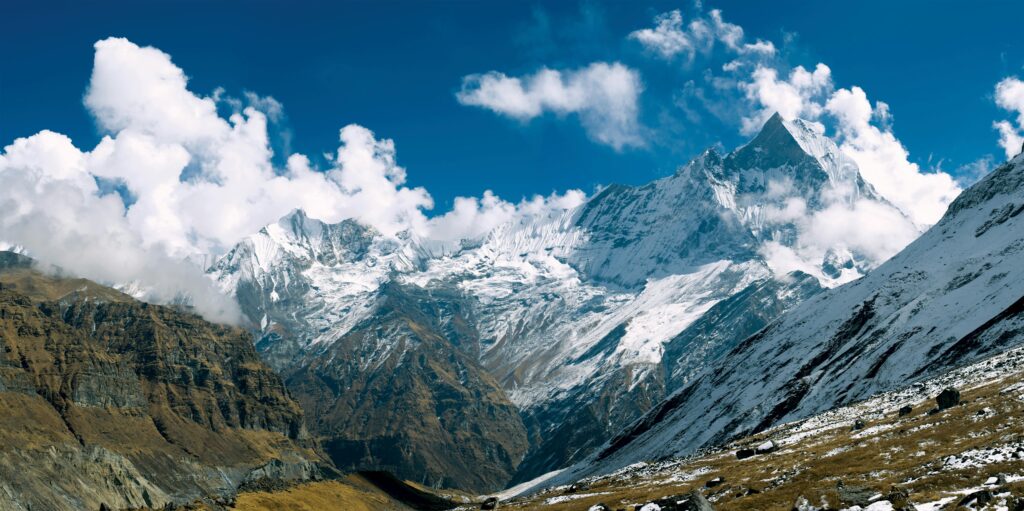
5,545 m (18,192 ft) at the Kala Patthar sunrise viewpoint
Trek Grade / Difficulty
Moderate to Strenuous
Start & End Point
Kathmandu, Nepal (with round-trip domestic mountain flights to Lukla Airport)
Accommodation Type
Cozy Mountain Teahouses & Lodges
Daily Walking Hours
5 to 7 hours of hiking per day
The classic 14-day Everest Base Camp Trek from Kathmandu: fly to Lukla, walk through Namche Bazaar, Tengboche and Dingboche with two acclimatisation days, stand at Everest Base Camp (5,364 m) and watch sunrise on Everest from Kala Patthar (5,545 m). Lukla flights, licensed guide, porters, permits, 2 hotel nights in Kathmandu and all meals on the trek included. From $1,485 per person.
What Makes This Tour Special
Hot Showers Available (Pay Locally)
Attached Bathrooms (Lower Lodges)
Heated Teahouse Dining Rooms
24/7 Kathmandu Emergency Line
Porter Service (1:2 Ratio)
Framed Completion Certificate
Lukla Flights
Duration Of Activity
14-Day Tour
Day 1Welcome to Kathmandu!Day 2Kathmandu - Lukla (Flight)Day 3Phakding to Namche Bazaar+11 more
Note: Times are based on the product's local country timezone.
14-Day Itinerary Overview
14 day segments
·
Total duration: 14 Days
Day 1Welcome to Kathmandu!
Day 2Kathmandu - Lukla (Flight)
Day 3Phakding to Namche Bazaar
Day 4Acclimatization Day in Namche Bazaar
Day 5Trek from Namche Bazaar to Tengboche Monastery
Day 6Trek from Tengboche to Dingboche
Day 7Acclimatization Day in Dingboche
Day 8Trek from Dingboche to Lobuche
Day 9Trek from Lobuche to Gorak Shep
Day 10Sunrise Ascent of Kala Patthar & Descend to Pheriche
Day 11Trek from Pheriche to Namche Bazaar
Day 12Trek from Namche Bazaar back to Lukla
Day 13Flight back to Kathmandu
Day 14Departure from Kathmandu
This is an overview. The full day-by-day itinerary is below.
On average, this activity is booked 36 days in advance
What travellers say
4.996 reviews·99% recommend
AS
Arnav SinghPune, India · May 28, 2025
Did this with my brother and it was the bonding experience we needed after years of adult life pulling us in different directions. Day 8 to Lobuche we were both struggling with altitude and walked very slowly, side by side, not saying much — and it was the most connected I've felt to him in years. Kala Patthar sunrise we both stood in silence for a long time. No words needed. That's what the mountains do.
KA
Kwame AsanteAccra, Ghana · May 27, 2025
I want to specifically say that the cultural experience goes far beyond the mountains. The Sherpa people, their Buddhist faith, their relationship with mountains they consider sacred — spending 14 days immersed in that world genuinely changed my perspective. Guide Pasang was a natural teacher of his culture, sharing it generously and thoughtfully. The mountains were the backdrop; the culture was the heart.
LB
Luca BianchiRome, Italy · May 27, 2025
The Lukla flight alone is worth the trip. Nothing prepares you for that 20-minute flight banking between Himalayan peaks and landing on that tiny uphill runway with a cliff at the end. Then you step out and the Himalayas are just everywhere. 14 days later at Kala Patthar watching Everest in the dawn light, I understood why people dedicate their lives to these mountains. Our guide Tenzing was world class.
Exclusive Discounts for Everest Base Camp Trek
Save up to 5%4 offers · Best: Standard 5% OFF for Everyone!
CodeEBC5
More offers
Click "Get Code" to reveal discounts. Only one code per booking.
Your discount codes4 available now · one code per booking
★ Best value
SAVE
5
% OFF
% Off5% OFF
Standard 5% OFF for Everyone!
No matter who you are or how many times you've booked with us — you always save! Enjoy a flat 5% discount on all bookings, Because every trip deserves a little extra!
You save about $ 74.25 per person · pay $ 1,410.75
✓ Everyone qualifies🚫 Non-refundable
EBC5
GROUP
👥
deal
Tiered$ 100–$ 200 OFF
Bring Your Crew & Save: Multi-Traveler Group Discounts
The larger your squad, the lower your per-person rate! Enjoy automatic, tiered discounts applied instantly at checkout when booking together, making it easier than ever to gather your team and stand at the foot of Mount Everest.
1 personFull price
2–6 people$ 100 OFF
7–14 people$ 150 OFF
15+ people$ 200 OFF
👤 The bigger your group, the bigger the discount🚫 Non-refundable
Special Group Deal: 10% OFF for 15 or More People!
Traveling with a big group? We’ve got you covered! Enjoy an exclusive 10% discount when you book for 15 or more guests. The more, the merrier – and the more you save!
You save about $ 148.50 per person · pay $ 1,336.50
🏢 Corporate group of 15+
SGEBC10
SAVE
🎁
SpecialDiscount
Solo-Traveler Friendly: No Added Single Supplement Fees
Exploring the Himalayas solo shouldn't mean paying extra penalties. On all of our fixed-date group departures, we pair solo adventurers with a same-sex roommate in our cozy mountain teahouses at no additional cost.
International flights and airport departure taxes.
Nepal tourist visa fees.
Lunch and dinner in Kathmandu.
Extra accommodation, meals, and transport if returning early.
Hot showers and hot water on the trek.
Charging fees for phones, cameras, and power banks.
Wi-Fi and internet packages.
Personal drinks, snacks, alcoholic beverages, and specialty coffees.
Mandatory high-altitude travel insurance and emergency evacuation coverage.
Expenses caused by Lukla flight delays or cancellations.
Optional helicopter transfers during flight disruptions.
Personal trekking gear and equipment rental.
Crew tipping and gratuities.
Drone permits and related authorization fees.
Detailed Day-by-Day Itinerary
Itinerary reviewed each season by Lead Guide Pasang Sherpa (62 EBC completions, government-licensed, wilderness first-aid certified) to reflect current trail conditions and 2026 CAAN regulations. Your guide can reorder Kala Patthar and Base Camp days based on weather and group condition.
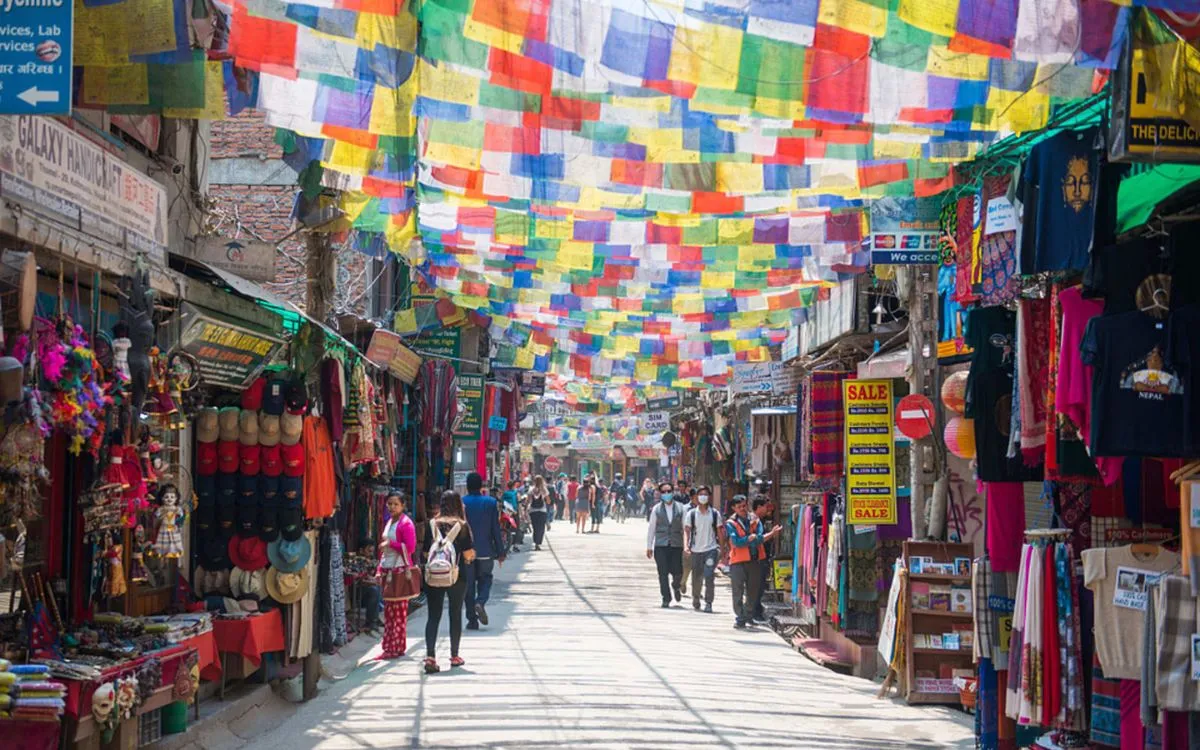
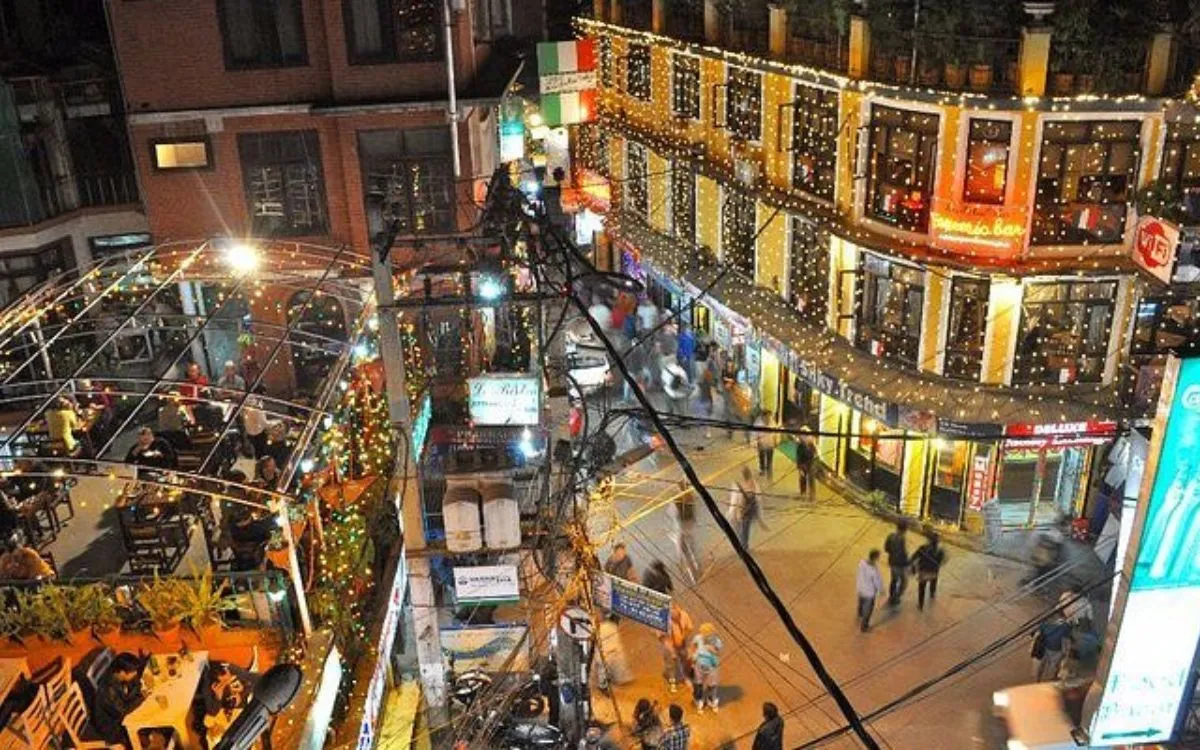
Welcome to Nepal! Our representative meets you at Tribhuvan International Airport (KTM) with a name card and drives you in a private vehicle to your 3-star hotel in Thamel, Kathmandu's lively travellers' district.
Later in the day your lead guide meets you for the pre-trip briefing. We go through the 14-day route, check your trekking gear, collect the documents for your permits and explain our altitude safety rules. Anything missing can be rented in Thamel the same evening. Get an early night — the Lukla flight leaves early.
📒 Guide Tip:
Tell your guide exactly how you feel before the trek starts. If you have concerns about fitness, medication, previous altitude experience or equipment, this is the best time to discuss them.
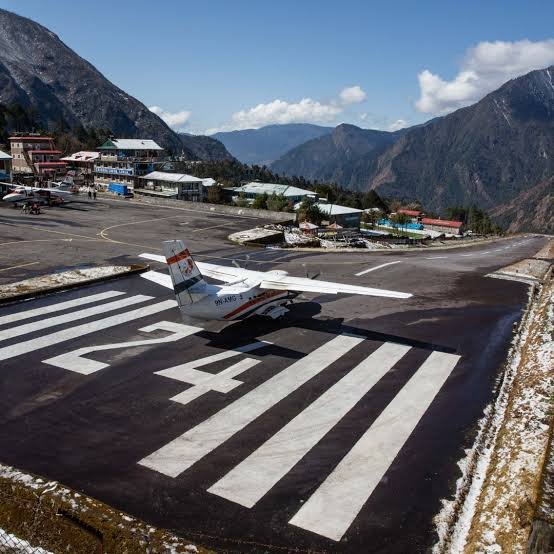
Your trek begins! After an early breakfast (or a packed breakfast) we transfer to the airport for the famous mountain flight to Tenzing-Hillary Airport in Lukla (2,840 m). The 30-minute flight passes green terraced valleys and the snow peaks of the eastern Himalaya. In peak season the flight usually leaves from Manthali Airport in Ramechhap instead, after an early drive from Kathmandu. Read our Kathmandu to Lukla flight guide for the Ramechhap rule, baggage limits and what to expect on flight day.
In Lukla we meet our porters, have a cup of tea and set off down the Dudh Koshi river (the "River of Milk"), through pine forest and over prayer-flag suspension bridges, to the quiet village of Phakding (2,610 m).
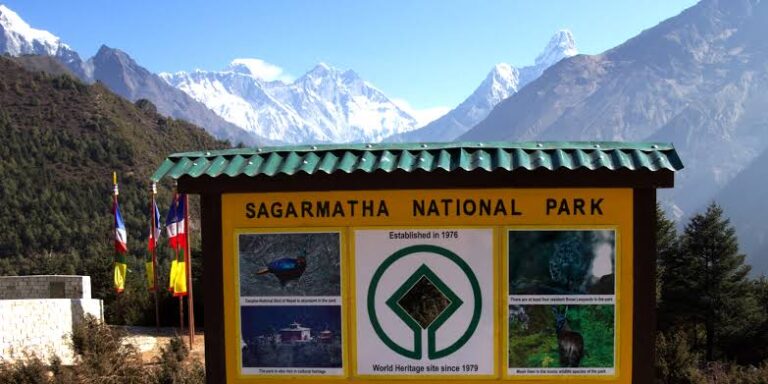
We follow the Dudh Koshi upstream through pine forest and over suspension bridges, past the Sherpa villages of Benkar, Monjo and Jorsalle. At Monjo we enter Sagarmatha National Park and show our permits.
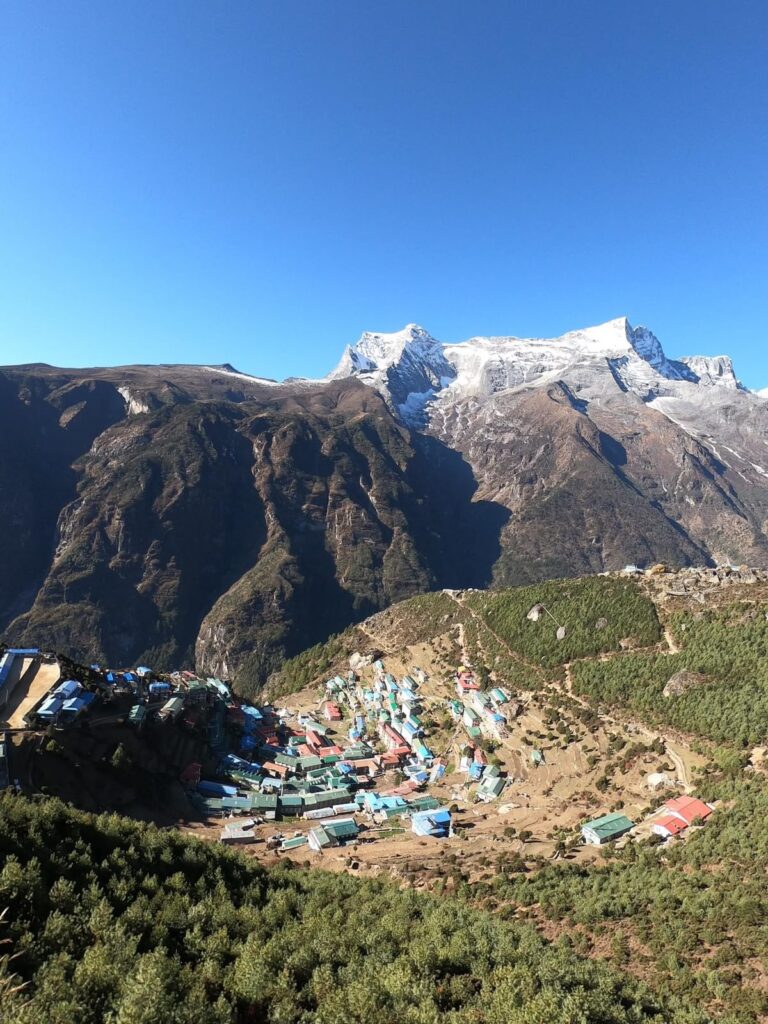
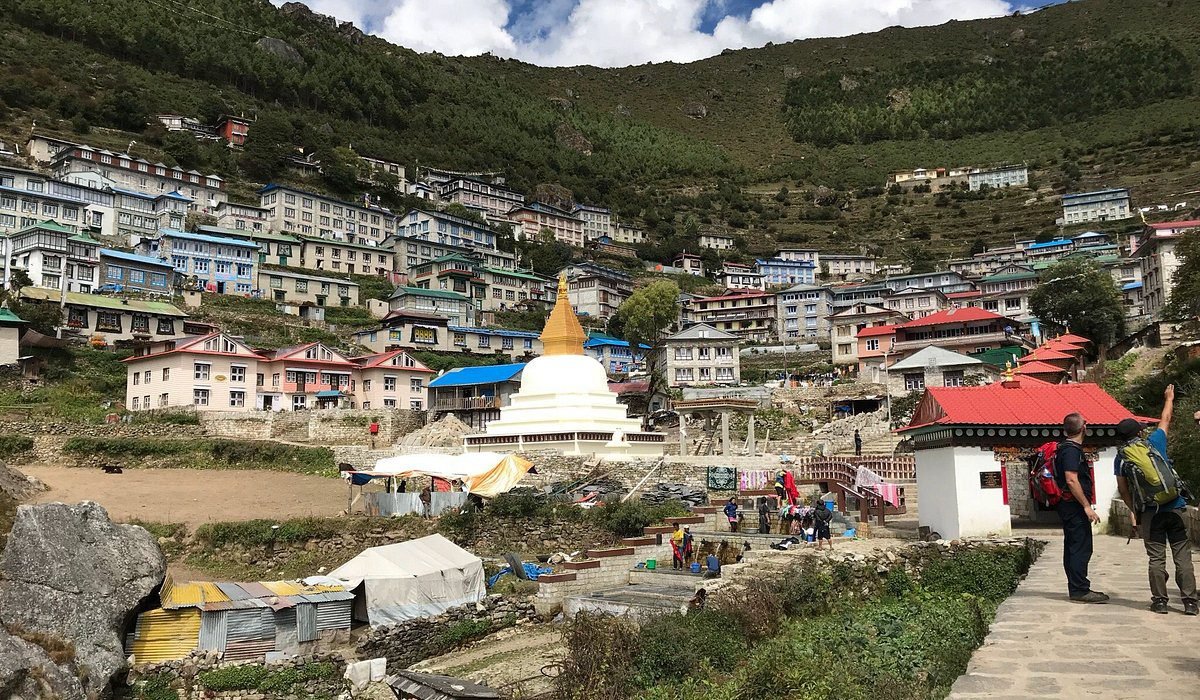
After lunch in Jorsalle we cross the high Hillary Suspension Bridge and start the steady 2–3 hour climb to Namche. On a clear day you see Everest for the first time from Top Danda, halfway up. We finish in Namche Bazaar (3,440 m), the busy, horseshoe-shaped heart of the Khumbu.
📒 Guide Tip:
The climb after the Hillary Bridge gains about 600 m. Walk slowly, drink often and don't race the people around you.
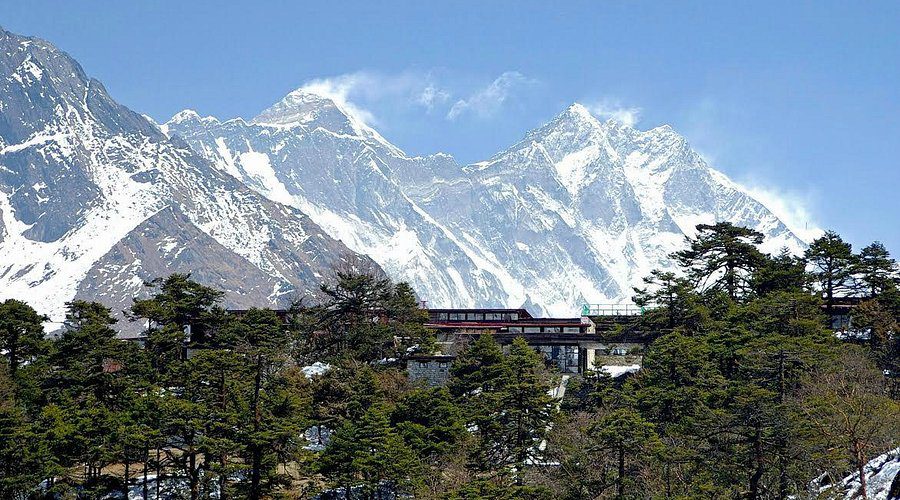
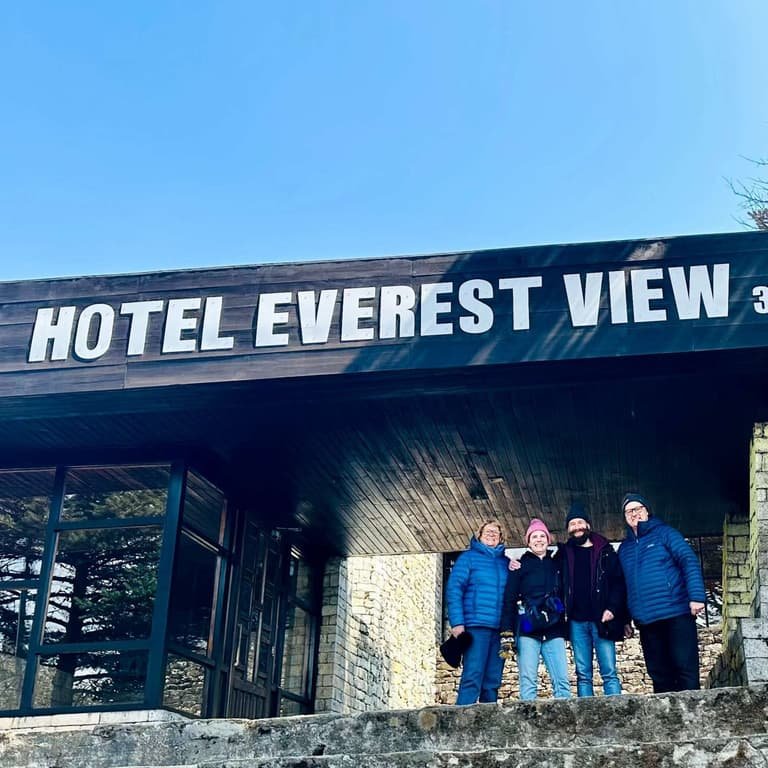
Today your body adjusts to the altitude. Following the "climb high, sleep low" rule, we hike up to Hotel Everest View (3,880 m) above Namche. From the ridge you see Everest, Lhotse, Nuptse and Ama Dablam, and we stop for a hot lemon-ginger tea on the terrace.
On the way down we loop through Khunde and Khumjung, visiting Khumjung Monastery (home of the famous "yeti scalp") and the school Sir Edmund Hillary founded. Back in Namche, the afternoon is free for bakeries, cafes and the Sherpa culture museum.
📒 Why We Don't Cut This Day: The acclimatisation stops at Namche and Dingboche are the first thing travellers ask to remove. Our answer: please don't. Climbing to 3,880 m and sleeping at 3,440 m is what prepares you for the days above 4,000 m. Trekkers who keep their rest days are the ones who reach Kala Patthar.
We leave Namche on a wide balcony trail with some of the best views of the trek: Everest, Lhotse, Nuptse and Ama Dablam. Watch for Himalayan tahr and the colourful danphe pheasant, Nepal's national bird.
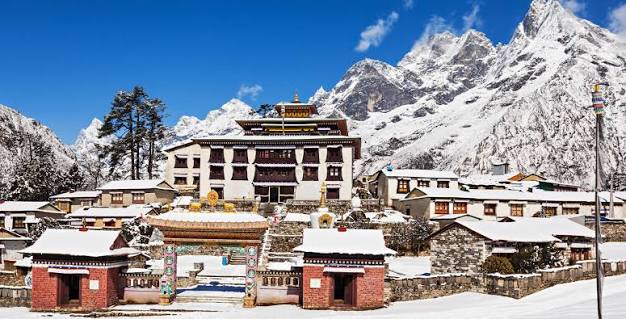
The trail drops through forest to Phunki Thenga (3,250 m) for lunch, then climbs for 2–3 hours through rhododendron and birch to the saddle of Tengboche. Tengboche Monastery is the largest in the Khumbu; if the timing is right, sit quietly inside during the monks' afternoon prayers.
Step outside at dawn for sunrise on Ama Dablam behind the monastery. After breakfast we drop through forest to Deboche, cross the Imja Khola and climb to Pangboche (3,985 m), one of the oldest Sherpa villages.
Above the tree line the valley opens out. After lunch in Somare we walk across high pastures and past stone-walled fields to the wide bowl of Dingboche (4,410 m), where yaks graze below Ama Dablam and Lhotse.
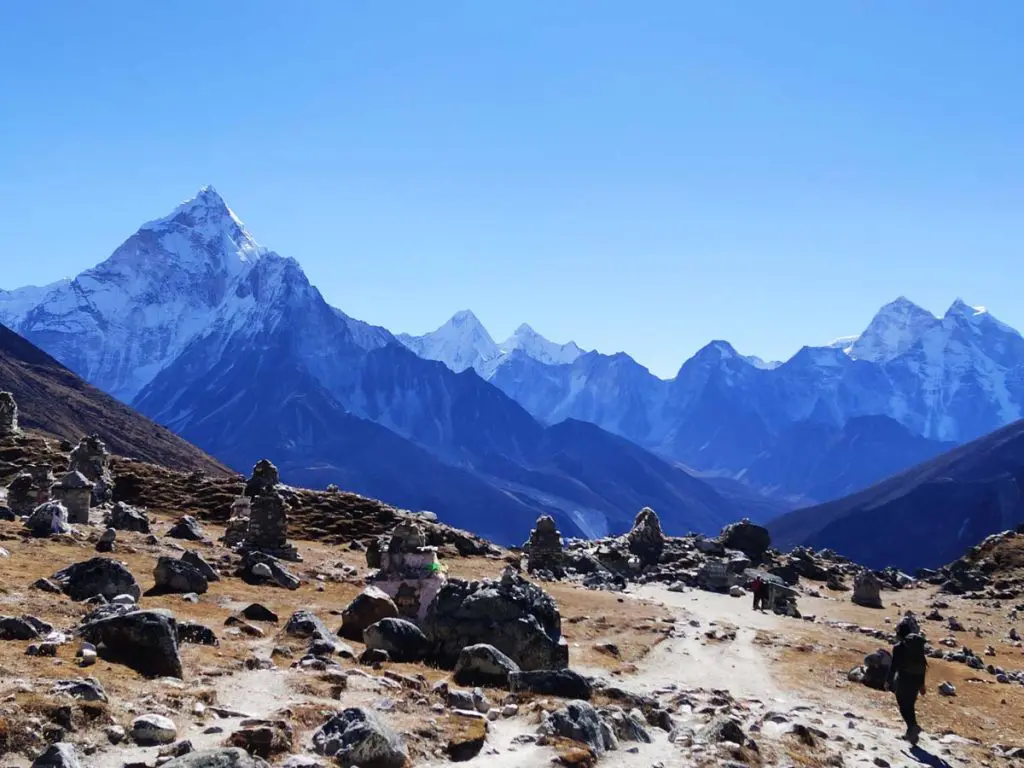
Our second rest day prepares you for the days above 5,000 m. We climb slowly up the ridge of Nangkartshang Peak (about 5,080 m) behind the village. From the top you see Lhotse, Makalu (the world's fifth-highest mountain), Island Peak, Cholatse, Taboche and the Imja Valley.
We come back down to Dingboche for lunch. Spend the afternoon resting, drinking 3–4 litres of water and perhaps enjoying a pastry at one of the village bakeries. Fit trekkers can ask about the gentler walk towards Chhukung instead.
We climb gently along a wide valley above Pheriche, with Taboche, Cholatse and Lobuche East above us. After about 3 hours we reach Thukla (4,620 m) for lunch.
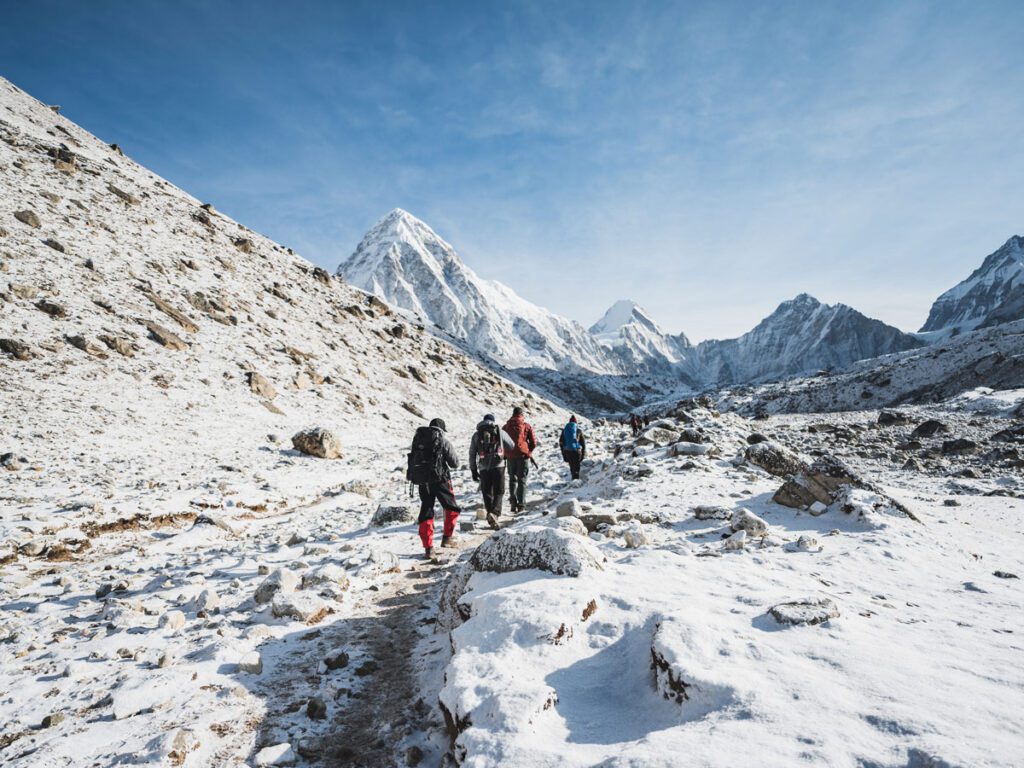
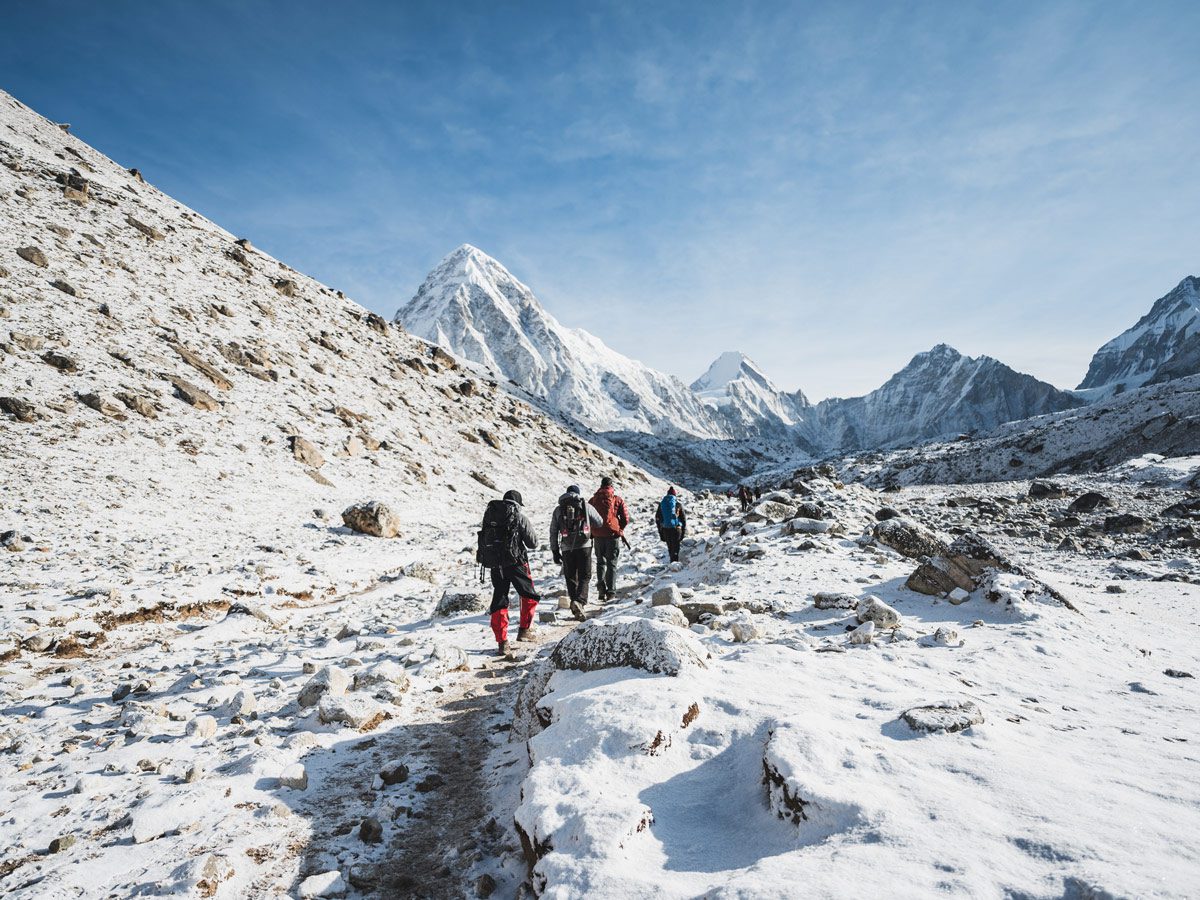
Then comes the steep, hour-long climb to Thukla Pass, where stone memorials remember climbers and Sherpas who died on Everest. After a quiet pause we follow the Khumbu Glacier moraine to Lobuche (4,910 m).
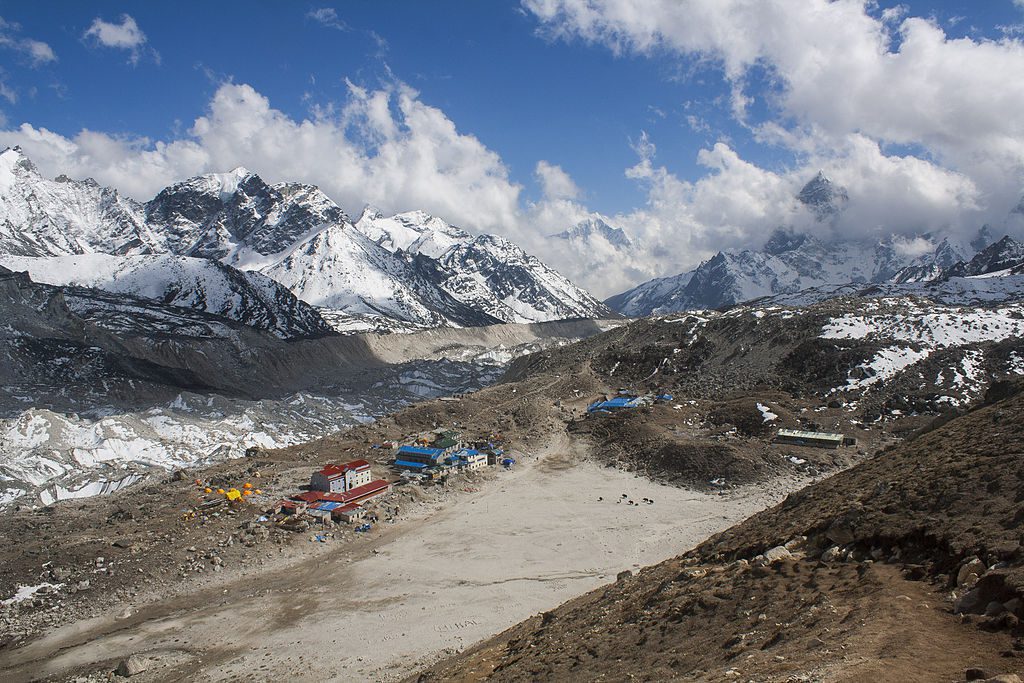
The day you trained for. We follow the Khumbu Glacier — one of the highest glaciers in the world — over rocky ground and past the Italian Pyramid research station to the frozen sandy lakebed of Gorak Shep (5,164 m), arriving around midday.
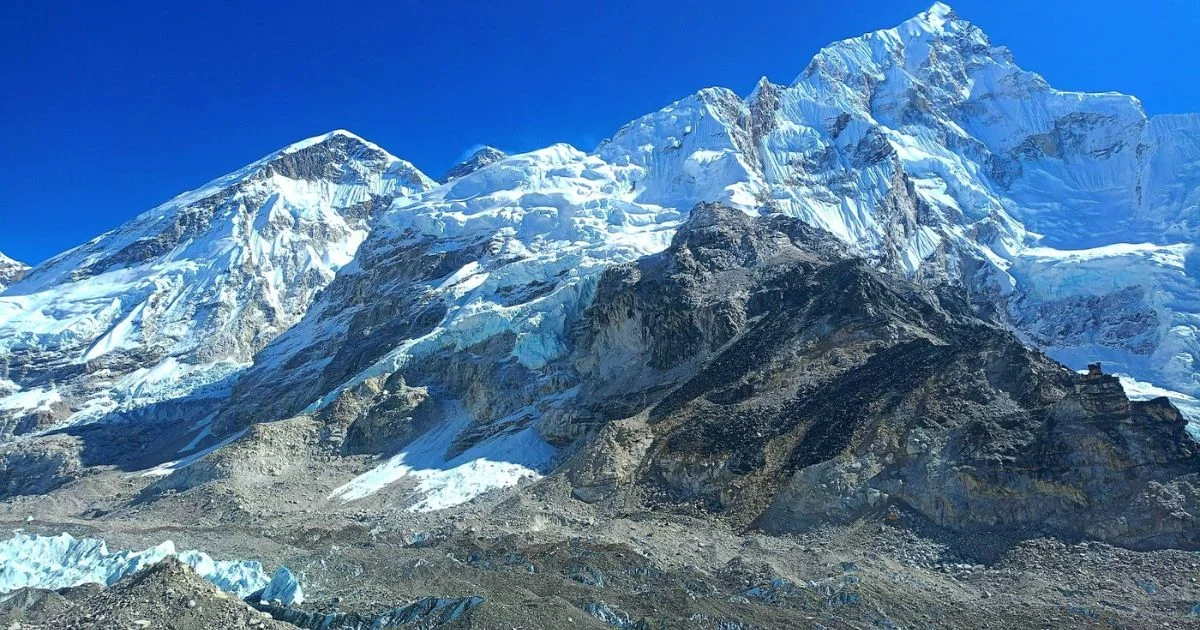
After lunch we leave heavy bags at the lodge and walk about 2 hours along the glacier moraine to Everest Base Camp (5,364 m). The prayer-flag boulders come into view, with the ice towers of the Khumbu Icefall right above. You made it! After photos at the famous EBC rock, we walk back to Gorak Shep for a warm dinner and early night.
We start around 4:00 AM with head torches and every warm layer for the 1.5–2 hour climb up Kala Patthar (5,545 m / 18,192 ft), the highest point of the trek.
As the sun rises behind Everest, the summit turns gold, with Lhotse, Nuptse, Pumori and Changtse all around — the classic Everest view you came for. Back in Gorak Shep for breakfast, we pack up and walk down past Lobuche and the Thukla memorials into the wide valley of Pheriche (4,240 m), where breathing feels noticeably easier.
📒 Sunrise Tip: Everest's face turns golden at sunrise. Arrive before 5:30 AM for the best light. Your guide sets the start time based on conditions.
With more oxygen in every breath, the walk down the Khumbu Valley feels easy. We follow the Imja Khola through Pangboche, past Tengboche Monastery and down through forest to Phunki Thenga for lunch.
A final climb along the balcony trail brings us back to Namche Bazaar in the afternoon. Celebrate with a hot shower, a real coffee and a slice of apple pie.
Our last trekking day. We descend the switchbacks to the Hillary Suspension Bridge, leave the national park at Monjo and follow the Dudh Koshi back through Phakding. The final hour is a gentle climb into Lukla.
In the evening we share a celebration dinner with the whole crew and say goodbye to our porters, who walk home from here.
We take the morning flight from Lukla back to Kathmandu (or to Manthali Airport in Ramechhap in peak season, followed by a 4–5 hour private drive). Look out of the window for one last view of the peaks.
After the transfer to your hotel, the afternoon is free for a massage or souvenir shopping in Thamel. In the evening we host a farewell dinner with a cultural show and present your trek completion certificate.
📒 Flight Note:
Book your flight home for at least 2 days after this date. If the Lukla flight is delayed, we rebook you on the next available flight at no extra cost.
Enjoy a relaxed breakfast at your hotel. Depending on your flight time, our private vehicle takes you to Tribhuvan International Airport for your flight home — with memories of Everest, the Khumbu and its people that will stay with you for life.
🏨 Accommodation
3-Star Boutique Hotel in Thamel
BreakfastAirport transfer
High DemandLikely to sell out
Instant ConfirmationSecure checkout
Not satisfied with this itinerary?
Are you interested in planning a custom trip? It only takes 2 minutes.
Customize Your ItineraryTell us your preferences — we'll build it around you
1Trip details
2Your details
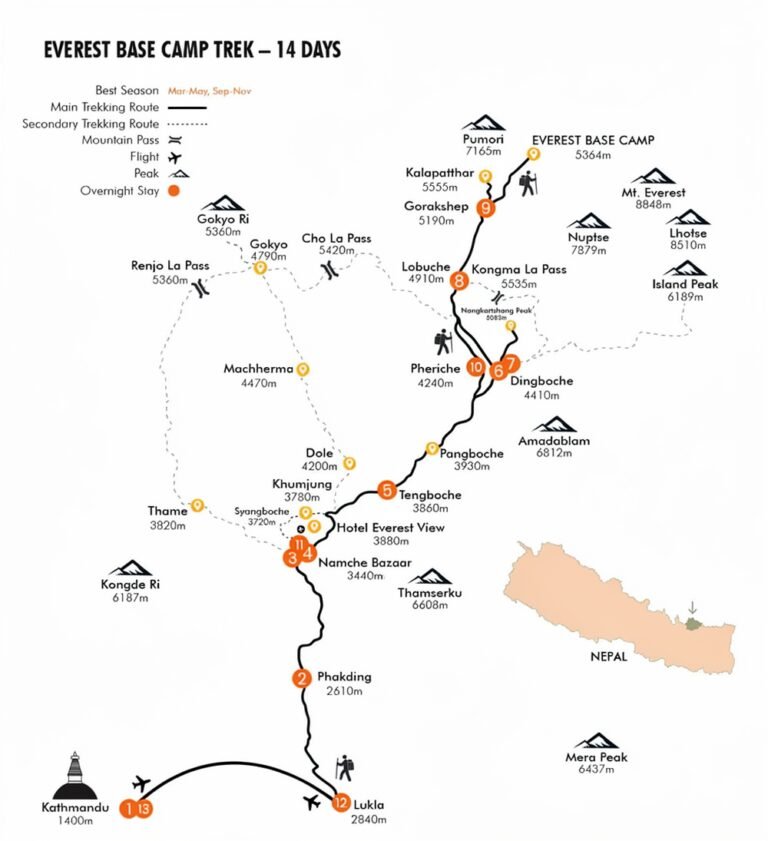
Elevation - Temperature - Route Map For EBC Trek
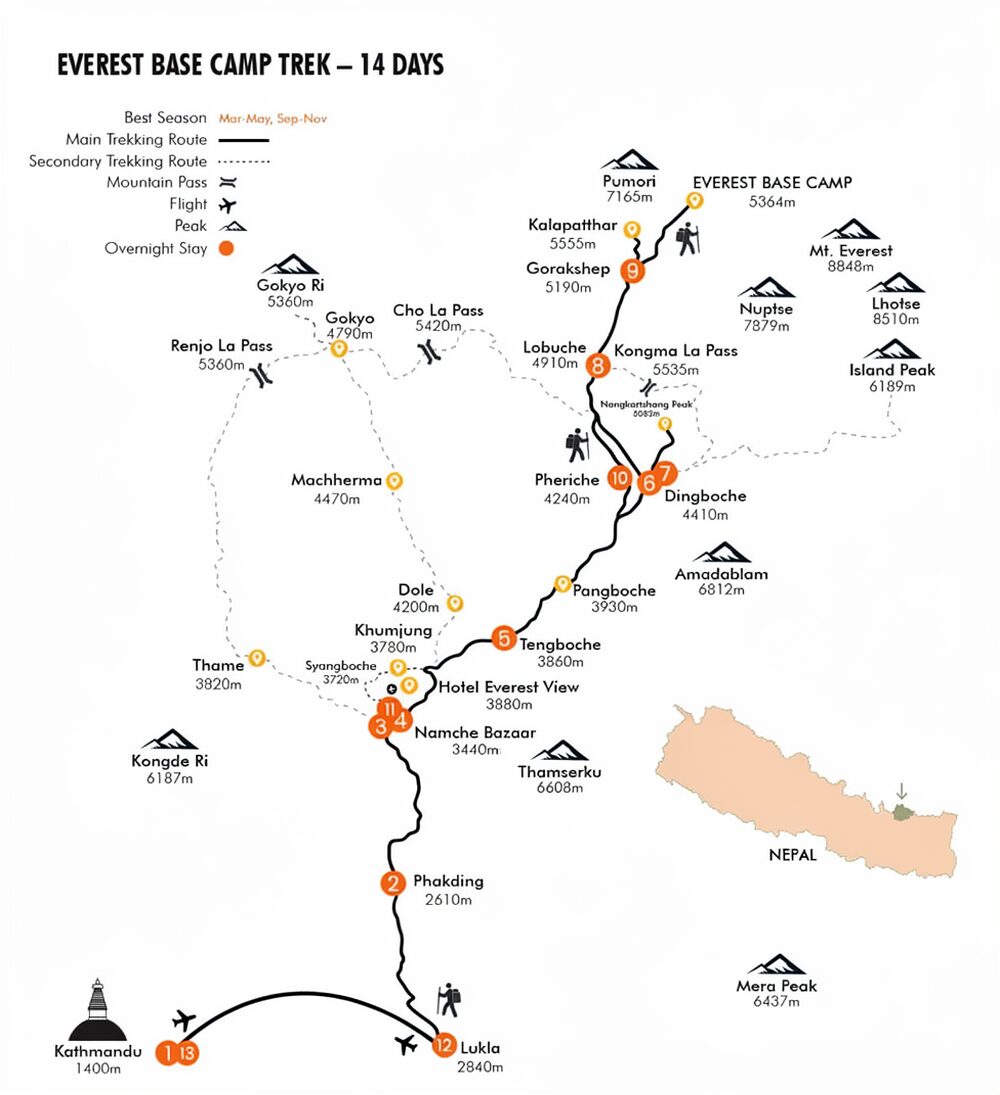
Highest: 5,545 m (Kala Patthar)130 Km total14 DaysModerate to Strenuous
Day 10Sunrise Ascent of Kala Patthar & Descend to Pheriche⛰ 5,545 mSummit / highlight
📍LocationKala Patthar
📏Distance13.5 km
🌡️Temperature7° / -18°C45° / -0°F
⏱️Walking7-8 Hrs
🏨AccommodationTea House
All days in a table
Day
Place
Altitude
Distance
Walking
Temperature
Accommodation
Day 1
Arrival in Kathmandu and Transfer to Hotel
1,400 m
—
—
25° / 8°C77° / 46°F
3* Hotel
Day 2
Flight to Lukla & Trek to Phakding
2,840 m
8 km
3-4 Hrs
18° / 0°C64° / 32°F
Tea House
Day 3
Trek from Phakding to Namche Bazaar (The Sherpa Capital)
3,440 m
10.7 km
5-6 Hrs
16° / -5°C61° / 23°F
Tea House
Day 4
Acclimatization Day in Namche Bazaar (Hike to Hotel Everest View)
3,880 m
6.2 km
4-5 Hrs
16° / -5°C61° / 23°F
Tea House
Day 5
Trek from Namche Bazaar to Tengboche Monastery
3,860 m
9.2 km
5-6 Hrs
14° / -8°C57° / 18°F
Tea House
Day 6
Trek from Tengboche to Dingboche (The Summer Valley)
4,410 m
11 km
5-6 Hrs
12° / -10°C54° / 14°F
Tea House
Day 7
Second Acclimatization Day in Dingboche (Hike to Nangkartshang Peak)
5,083 m
5 km
4-5 Hrs
12° / -10°C54° / 14°F
Tea House
Day 8
Trek from Dingboche to Lobuche
4,910 m
11.5 km
5-6 Hrs
8° / -15°C46° / 5°F
Tea House
Day 9
Trek from Lobuche to Gorak Shep & Stand at Everest Base Camp!
5,364 m
15 km
8-9 Hrs
5° / -18°C41° / -0°F
Tea House
Day 10
Sunrise Ascent of Kala Patthar & Descend to Pheriche
5,545 m
13.5 km
7-8 Hrs
7° / -18°C45° / -0°F
Tea House
Day 11
Trek from Pheriche to Namche Bazaar
3,440 m
14.5 km
6-7 Hrs
15° / -5°C59° / 23°F
Tea House
Day 12
Trek from Namche Bazaar back to Lukla (Final Trek Day)
2,840 m
19 km
7-8 Hrs
19° / 0°C66° / 32°F
Tea House
Day 13
Flight back to Kathmandu & Celebratory Farewell Dinner
1,400 m
—
—
25° / 8°C77° / 46°F
3* hotel
Day 14
Final Departure from Kathmandu
1,400 m
—
—
25° / 8°C77° / 46°F
3* hotel
Everest Base Camp Trek Map
Best time to visit
Choose the best season for your trek — Spring and Autumn offer the clearest skies and best trail conditions. (Temperature is for the reference only and may not be accurate)
Rain, clouds, lower visibility and wetter trails; June can be better than July–August
Less favorable
🍂
AutumnOctober – November
Best season
9°-11°Hi / Lo °C
Post-monsoon clarity delivers the sharpest mountain views of the year. Most reliable weather window.
Best visibility — October is the finest single month.
❄️
WinterDecember – February
Cold / winter
-2°-18°Hi / Lo °C
Very cold at high altitude, snow can affect the trail, but clear days and views are possible
Possible but very cold
Best time to visit
Choose the best season for your trek — Spring and Autumn offer the clearest skies and best trail conditions. (Temperature is for the reference only and may not be accurate)
Jan: Cold / winter — -4°C high / -18°C low. Very cold winter.
Leave a MessageWe'll get back to you by email or WhatsApp
1Your message
2Your details
"Can I actually do this?"
Most travelers who reach this page come with that question in their mind — from London, Mumbai, Sydney, or Singapore. After helping 2,300+ trekkers reach the Khumbu, our honest answer: yes, if you can walk 5 to 7 hours a day on uneven ground for two weeks and take altitude seriously.
This is the full 14-day itinerary: eleven days on the trail from Lukla, with two deliberate acclimatisation stops, and Kala Patthar at 5,545 m for the Everest view that Base Camp itself doesn’t give you — at Base Camp the summit is hidden behind Nuptse.
Two things to be clear about: you will not stand on the 8,849 m summit, and you will not see it from Base Camp because the terrain blocks it. That’s why the sunrise climb of Kala Patthar follows the Base Camp day — from there you see the full face of Everest at sunrise.
📋
No summit pressure — ever. Our guides and porters are paid for the full 14 days whether you complete the trek or need to turn back at Lobuche. Nobody on the trail has a financial reason to push you further than is safe. If your body says stop, your guide says stop.
Is This Trek Right for You?
This trek is right for most healthy adults who want the full Himalayan experience on foot and have two weeks available. But it’s not right for everyone — we’d rather tell you honestly than have you arrive unprepared.
✗ You have fewer than 16–17 days in Nepal
Lukla flight delays are real. Squeezing this trek in with no buffer days creates unnecessary stress. Consider our EBC Helicopter Day Tour if time is very limited.
✗ You want Everest views without multi-day trekking Our EBC Helicopter Tour does this in about 5 hours from $1,499. No trekking fitness required — we land at Kala Patthar and have breakfast at Hotel Everest View.
✗ You have fixed international flights with no buffer days
Build 2–3 days between your Lukla return flight and your flight home. Lukla flights are often delayed by weather.
✗ You have a serious heart or lung condition without medical clearance Talk to your doctor before booking. We welcome travellers with written medical clearance. Our guides carry emergency oxygen and oximeters on every departure.
✗ You expect 4-star accommodation throughout Above Dingboche (4,410 m), teahouses are basic — shared bathrooms, cold nights, simple foam mattresses. Below that, many lodges have attached bathrooms and hot showers.
📋
If any of the above fits your situation, WhatsApp us — we’ll find the right experience for you.
Highlights
Stand at Everest Base Camp (5,364 m / 17,598 ft) beside the Khumbu Glacier and Icefall, where expedition teams camp each spring.
Watch sunrise from Kala Patthar (5,545 m / 18,192 ft) — the best close-up view of Everest, Nuptse and Lhotse, which you cannot get from Base Camp itself.
Fly into Lukla's Tenzing-Hillary Airport (2,840 m / 9,318 ft) on a scenic 30-minute mountain flight.
Walk through Sagarmatha National Park, a UNESCO World Heritage Site, with pine and rhododendron forest and a chance to see Himalayan tahr, musk deer and Nepal's national bird, the danphe.
Spend two nights in Namche Bazaar (3,440 m), the horseshoe-shaped Sherpa capital, with bakeries, gear shops and a Sherpa culture museum.
Hike to Hotel Everest View (3,880 m) for tea with a view of Everest, Lhotse and Ama Dablam, then visit Khumjung and the Hillary School.
Visit Tengboche Monastery (3,860 m), the largest in the Khumbu, and hear the monks' afternoon prayers.
Cross prayer-flag suspension bridges over the Dudh Koshi, including the high Hillary Suspension Bridge.
Enjoy family-run teahouses and hearty mountain food, including Dal Bhat with free refills.
Your Himalayan expedition kicks off with one of the most thrilling and scenic aerial experiences in the world. The 25-to-30-minute flight from Kathmandu rewards you with sweeping views of lush green valleys and the towering Eastern Himalayas before landing on Lukla's famous 527-meter sloped runway. As the official gateway to the Everest region, the bustling mountain town of Lukla instantly immerses you in the fresh alpine air and the rich Sherpa way of life.
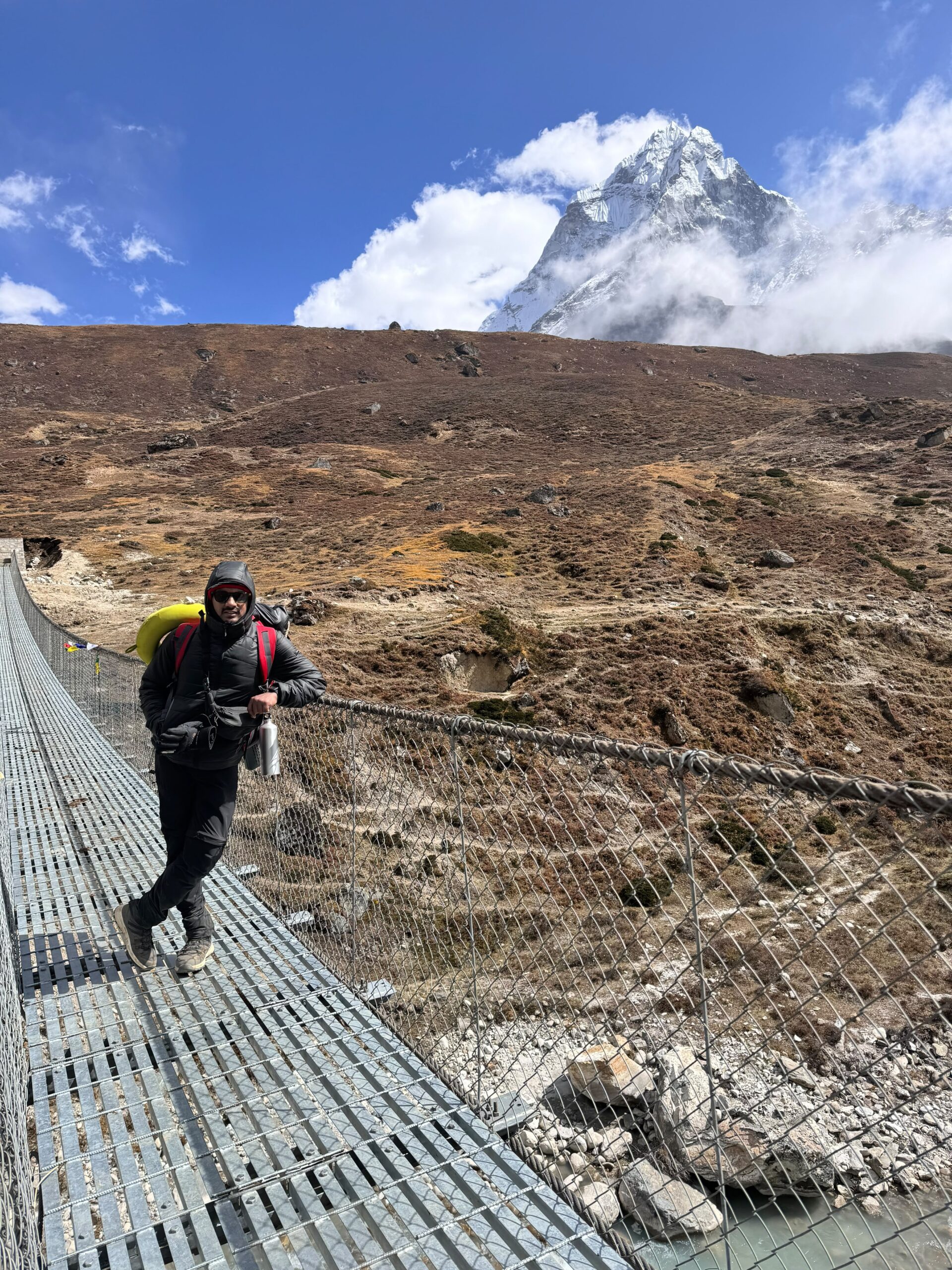
Suspended high above the roaring white waters of the Dudh Koshi River gorge, this iconic steel suspension bridge is a masterpiece of mountain engineering. Adorned with hundreds of colorful, fluttering Buddhist prayer flags, it hangs about 135 metres above the meeting of the Dudh Koshi and Bhote Koshi and is the highest and most famous of the suspension bridges crossed on your journey to Namche Bazaar. Walking across its swaying mesh pathway is an unforgettable milestone that will truly make you feel like an intrepid Himalayan explorer.
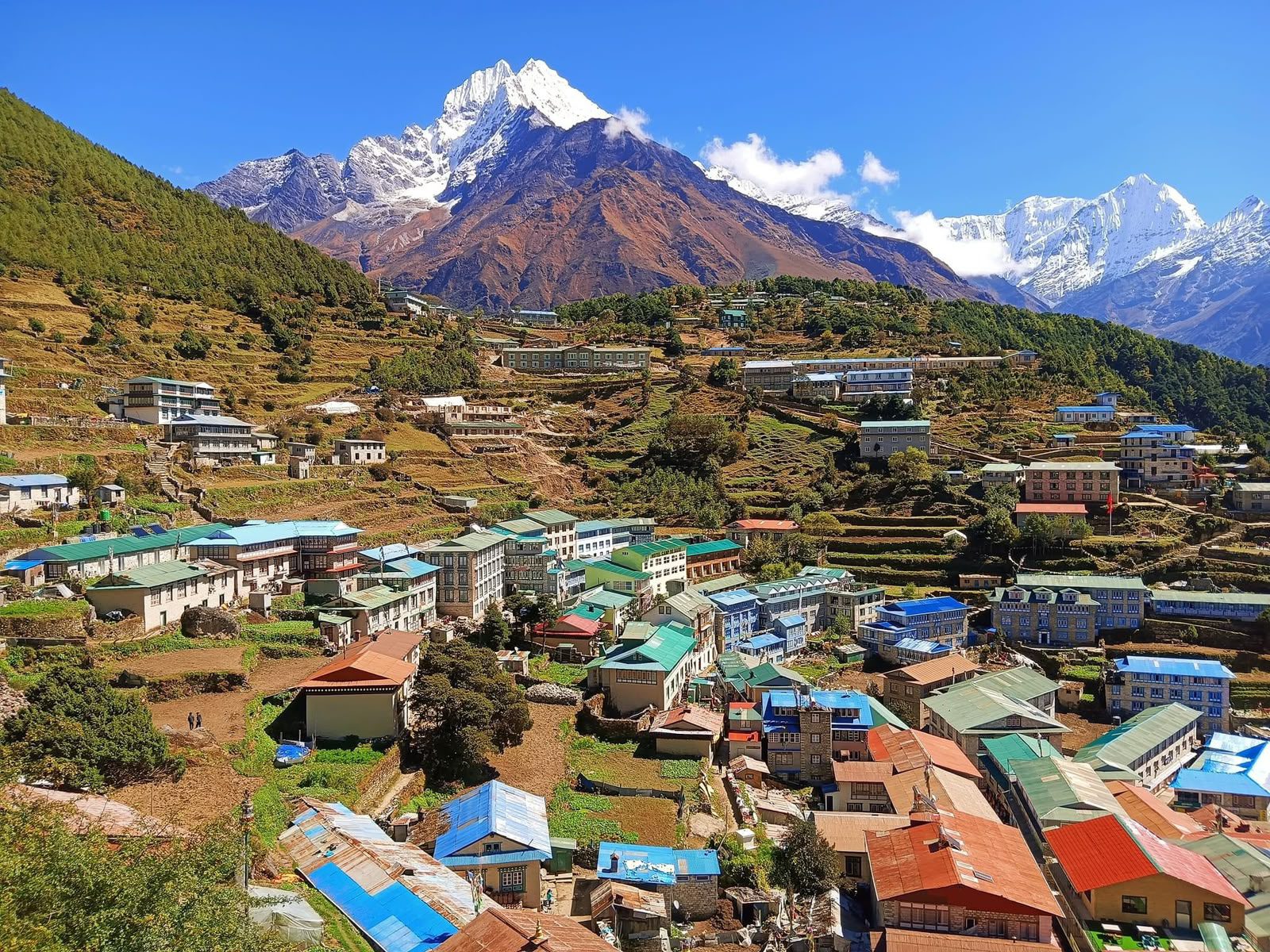
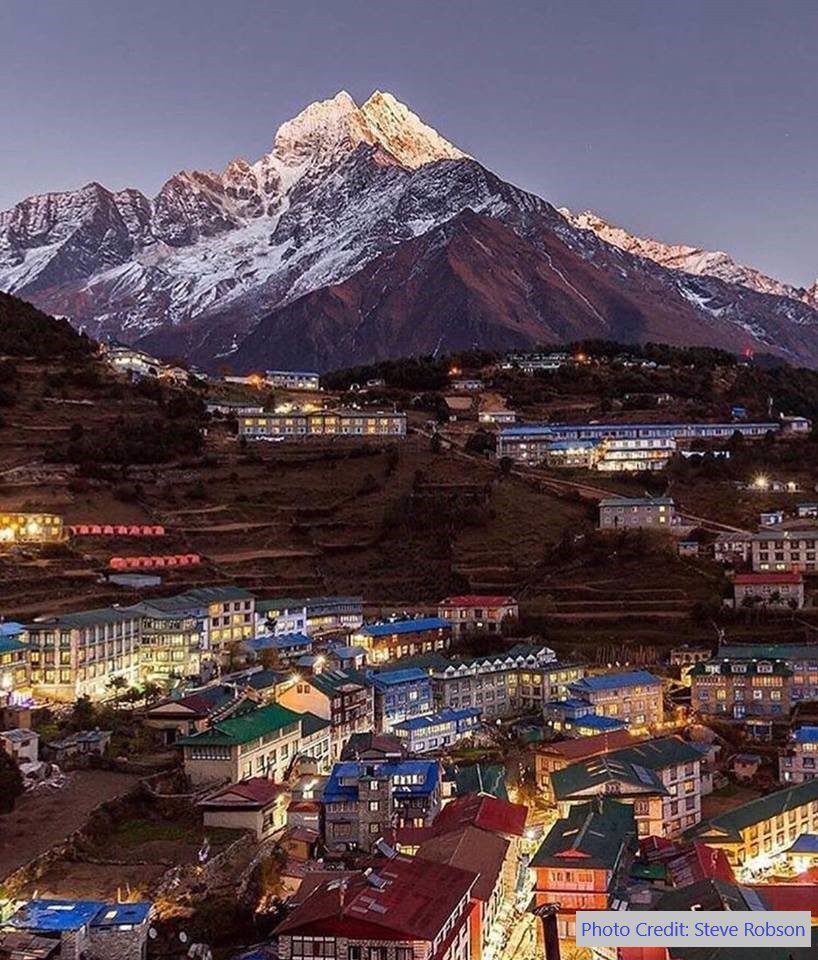
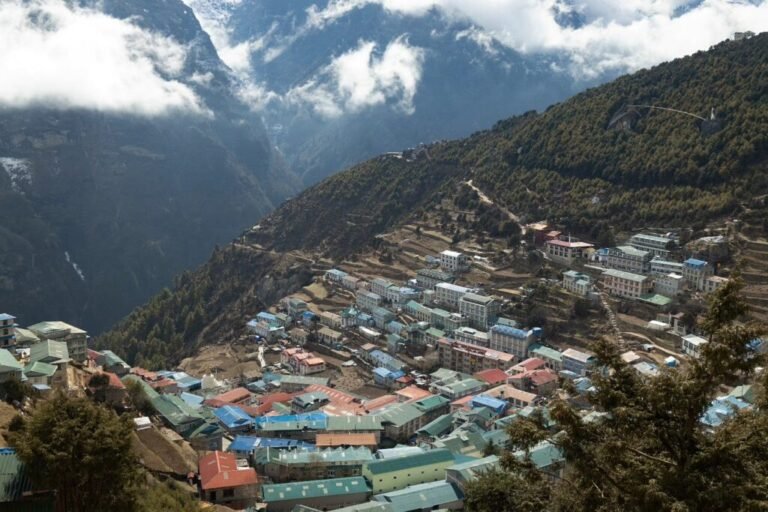
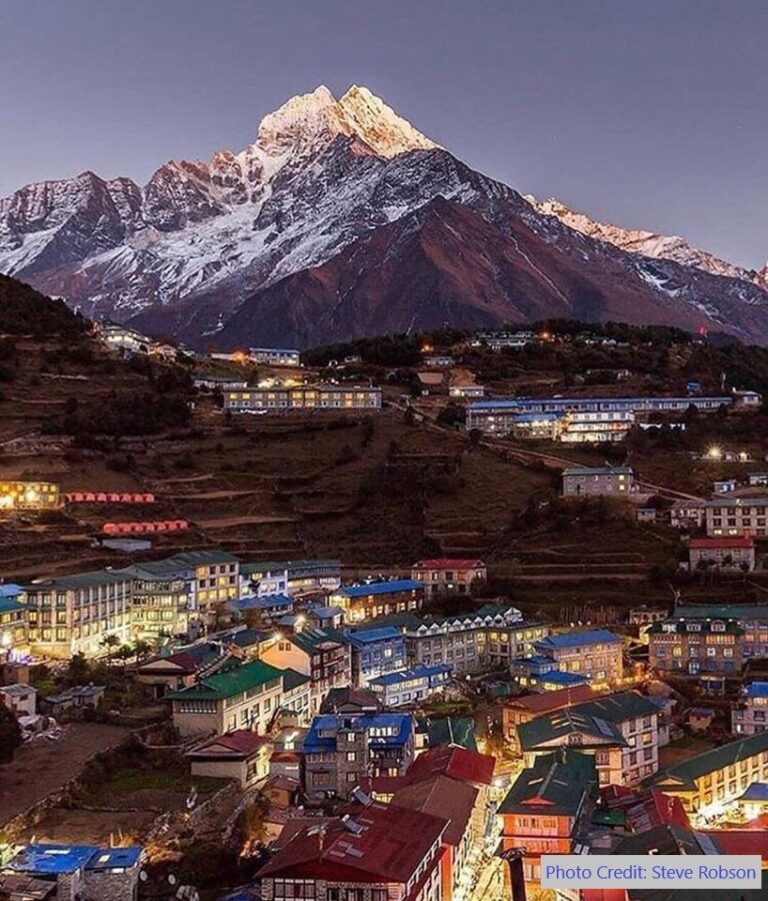
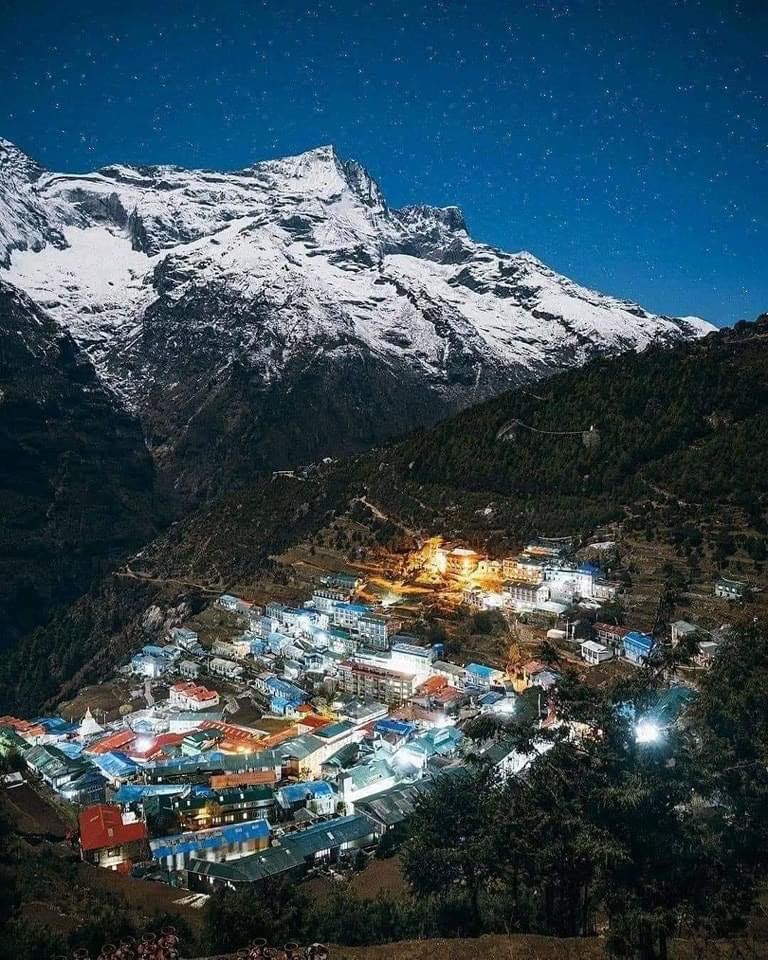
Carved like a giant horseshoe into a natural mountain amphitheater, Namche Bazaar is the bustling trading and cultural hub of the entire Khumbu region. It serves as your primary acclimatization haven. Here, traditional stone buildings stand side-by-side with modern cafes, bakeries, gear shops, and ATMs. You can spend your rest day exploring the Sherpa Cultural Museum or enjoying a warm drink while chatting with fellow adventurers from around the globe.
Perched on a scenic ridge above Namche, this legendary landmark is celebrated as one of the highest-placed hotels in the entire world. Sipping a warm cup of lemon ginger honey tea on its open-air panoramic terrace is an absolute highlight of the acclimatization process. On a clear morning, you are rewarded with your first completely unobstructed, jaw-dropping direct view of Mount Everest, Lhotse, Nuptse, and the breathtaking silhouette of Ama Dablam.
Nestled on a windswept saddle surrounded by dense rhododendron and juniper forests, Tengboche is the spiritual heart of the Everest region. The majestic monastery, originally founded in 1916, sits against a dramatic mountain backdrop, with the iconic peak of Ama Dablam framed directly behind it. Visitors are welcome to step inside to hear the deep copper horns and witness the local Buddhist monks chanting their peaceful afternoon puja prayers.
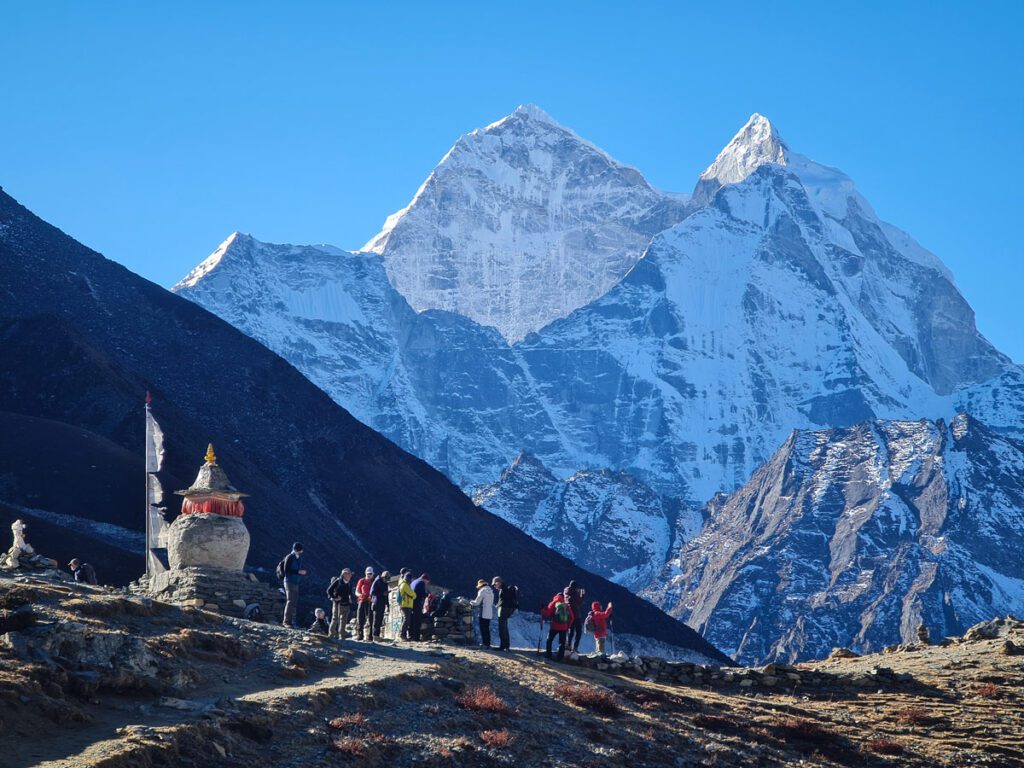
Situated on a windswept plateau at the head of the Khumbu Valley, this quiet, sacred monument is dedicated to the memory of brave Sherpas and mountaineers who lost their lives on Everest. Dozens of hand-built stone chortens and monuments draped in faded prayer flags stand in silent tribute. It is a deeply moving and reflective place on the trail, offering a powerful reminder of human determination and the raw, untamed power of the high Himalayas.
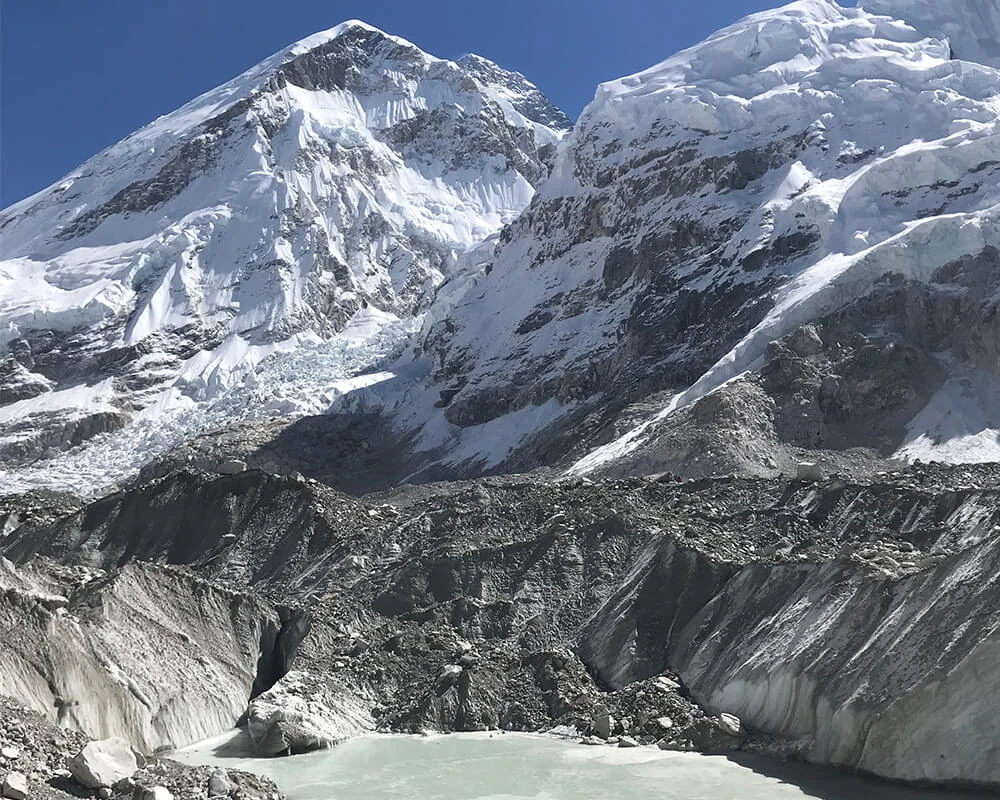
Stand at the literal foot of the world's tallest mountain—the ultimate destination of your 130-kilometer round-trip trek. Walking on the lateral moraine of the shifting Khumbu Glacier brings you face-to-face with the towering, cracked walls of the Khumbu Icefall. During the spring climbing season, the rocky basin transforms into a vibrant "city of tents," buzzing with the energy of elite global expeditions preparing to summit the peak.
Reaching the summit of the iconic "Black Rock" is the highest point of your trekking journey. Because Nuptse and Lhotse block the direct view of Everest's high summit from Base Camp itself, ascending Kala Patthar is an essential pilgrimage. Your guide will time your hike to witness the sun rise over the mountains, painting the snowy summits of Mount Everest, Lhotse, and Nuptse in a brilliant, glowing golden alpenglow.
Lukla flight delays are the most common disruption on the EBC trek. Here is exactly what happens when it occurs — step by step:
Flight Cancelled — You Hear It Early
Usually by 6:00–6:30 AM at the domestic terminal, sometimes the night before. Our InTicketo representative is at the airport with you. You are not alone in a queue trying to figure out what just happened.
We Check Options Within 30 Minutes
While you return to your hotel for breakfast, our Kathmandu operations team contacts airline dispatchers, helicopter operators, and Ramechhap Airport simultaneously. We know the dispatchers by name.
We Contact You Directly Within 2 hours, we call or WhatsApp you. You’ll hear exactly how many flights are queued ahead of yours, tomorrow’s mountain forecast, and our honest recommendation. If “wait — tomorrow looks better” is the right answer, we say that.
You Choose Your Path Rebook the same fixed-wing flight (costs a day — included). Wait (costs a hotel night at your expense). Helicopter upgrade ($450–500/person shared). We arrange whichever you choose.
All Trail Logistics Adjusted by Us Your teahouse in Phakding, your porter waiting in Lukla, your trail permit timing — we adjust every call behind the scenes. When you land, your bed is ready and your team is where they should be. No charge to you.
Situation
Who Covers the Cost
Standard Lukla fixed-wing flight
✓ Included in package
Rebooking after weather cancellation
✓ Included, no extra charge
Teahouse rebooking & trail logistics changes
✓ We handle it, no charge
Extra hotel night in Kathmandu due to delay
Your cost (~$50–80/night)
Helicopter charter — shared ($450–500/person)
Your cost · We arrange it
Helicopter charter — private ($3,000–3,500)
Your cost · We arrange it
EBC Trek In Short
Last updated: October 2026 — itinerary, permit fees and Lukla flight information checked for the 2026–2027 seasons.
The Everest Base Camp Trek 14 Days is the classic way to reach the foot of the world’s highest mountain on foot. You fly from Kathmandu to Lukla, walk 11 days through the Sherpa villages of the Khumbu, stand at Everest Base Camp (5,364 m) and climb Kala Patthar (5,545 m) for the sunrise view of Everest that you cannot see from Base Camp itself. Two rest days, in Namche Bazaar and Dingboche, give your body time to adjust — the main reason most trekkers who follow this itinerary reach Base Camp safely.
Everest Base Camp Trek at a Glance
Duration: 14 days Kathmandu to Kathmandu, with 11 days on the trail (including 2 acclimatisation days)
Distance: about 130 km (80 miles) round trip from Lukla
Highest points: Everest Base Camp 5,364 m (17,598 ft); Kala Patthar 5,545 m (18,192 ft)
Start and finish: Kathmandu, with flights to and from Lukla (2,840 m)
Difficulty: moderate to strenuous — no climbing skills needed, but 5–8 hours of walking a day at high altitude
Accommodation: 2 nights in a 3-star hotel in Kathmandu and 11 nights in mountain teahouses
Best time: March to May and late September to November
Price: from $1,485 per person, including Lukla flights, permits, guide, porters and all meals on the trek
Our 14-day trek costs from $1,485 per person on a group departure. That price covers the things that make up most of the cost of an EBC trek: return Lukla flights (or the Ramechhap shuttle in peak season), the Sagarmatha National Park and Khumbu municipality permits, a licensed guide and porters for 11 days, 11 teahouse nights with three meals a day, 2 hotel nights in Kathmandu and airport transfers. On top of that, budget for your international flights, Nepal visa, travel insurance with helicopter rescue cover, tips for your crew (usually 10–15% of the trip price) and about USD 20–25 a day for drinks, hot showers, charging and Wi-Fi on the trail. See our full Everest Base Camp trek cost breakdown and exactly what is included.
How Hard Is the Everest Base Camp Trek?
The trek is rated moderate to strenuous. The trail is well made and needs no climbing skills, but you walk 5–8 hours a day for 11 days, and the altitude is the real challenge: above 4,000 m there is about 40% less oxygen in each breath. If you can hike 15 km on hilly ground with a light pack and do it again the next day, you can train to complete this trek. Our guides check your blood oxygen twice a day, carry emergency oxygen and follow a simple rule: if your symptoms get worse, you go down. Read our honest guide to how difficult the EBC trek really is and whether a beginner can do it.
Best Time to Trek to Everest Base Camp
The best seasons are spring (March to May), with rhododendrons in bloom and climbing expeditions at Base Camp, and autumn (late September to November), with the clearest skies of the year. Winter (December to February) is quiet and clear but very cold; the monsoon (June to August) brings cloud, rain and frequent Lukla flight delays.
Permits You Need
You need two permits for the Everest region: the Sagarmatha National Park entry permit and the Khumbu Pasang Lhamu Rural Municipality entry permit. The TIMS card is not used in the Khumbu. Both permits are included in our price, and we handle all the paperwork for you.
Sherpa Culture and Sagarmatha National Park
The entire route lies inside Sagarmatha National Park, a UNESCO World Heritage Site. You cross the high Hillary Suspension Bridge, spend two nights in Namche Bazaar, the Sherpa capital, visit the school Sir Edmund Hillary built in Khumjung, listen to the monks’ afternoon prayers at Tengboche and pass the climbers’ memorials at Thukla Pass before reaching the Khumbu Glacier.
Which Everest Trek Is Right for You?
First time at high altitude, two weeks available: this 14-day trek, with two rest days.
Short on time but fit: ask us about our 7-day EBC Short Trek with helicopter return.
Experienced and want more: ask us about the 18-day Everest Three Passes Trek over Kongma La, Cho La and Renjo La, with Gokyo Lakes.
Fitness: moderate to high fitness needed; expect 5–8 hours of walking a day on rocky trails with steep climbs.
Altitude: highest point Kala Patthar 5,545 m (18,192 ft); Everest Base Camp 5,364 m. Two acclimatisation days are built in.
Best time: March–May (spring) and late September–November (autumn).
Weather: cold mornings and nights, possible snow higher up; bring layers and waterproofs.
Flights: in peak season Lukla flights leave from Manthali/Ramechhap (4–5 hours' drive from Kathmandu); off-season from Kathmandu. Keep 2–3 buffer days after the trek.
Accommodation: 3-star hotel in Kathmandu and twin-sharing teahouses on the trek; private rooms at extra cost.
Meals: breakfast in Kathmandu; breakfast, lunch and dinner on trekking days; farewell dinner in Kathmandu.
Permits: Sagarmatha National Park permit and Khumbu Pasang Lhamu Rural Municipality permit, both included. No TIMS card is needed in the Everest region.
Packing: broken-in trekking boots, poles, warm layers, gloves, hat, sunglasses, sunscreen, water bottle and personal medicines. Sleeping bag and down jacket are provided.
Travel insurance: mandatory, covering trekking up to 6,000 m and helicopter evacuation.
Connectivity: mobile signal to around Namche; paid Wi-Fi in most villages above.
Culture: walk clockwise around stupas and mani walls and ask before photographing people.
Honest Talk: Who Can Do the EBC Trek?
The EBC Trek is right for you if:
You can walk 5–8 hours a day for 11 days in a row
You can carry a 6–8 kg daypack
You have no serious heart, lung or blood-pressure conditions (or have your doctor's clearance)
You are happy sleeping in simple, cold teahouses
You accept some discomfort as part of the adventure
You are roughly 10 to 75 years old (trekkers at both ends of this range complete it regularly)
The EBC Trek is NOT for you if:
You have uncontrolled high blood pressure or a serious heart condition
You cannot comfortably walk 10 km on two days in a row today
You have less than 2 months to train (starting from low fitness)
You expect hotel beds and hot showers every night above Namche
The number one reason treks fail is altitude, not fitness — it affects athletes and weekend walkers alike. Our licensed guides check your blood oxygen twice a day, the itinerary has two acclimatisation days, and any worsening symptoms mean going down. We do not compromise on safety.
How Difficult is the Everest Base Camp Trek?
Classification: Moderate to Strenuous
The EBC trek needs no technical climbing skills — no ropes, crampons or ice axes. The trail is well marked and teahouses are a few hours apart. You do not need to be an athlete.
What you do need:
The ability to walk 5–8 hours a day with a 6–8 kg daypack
Endurance for long uphill sections
Mental resilience for 11 days on the trail in a row
Respect for altitude — fitness does not protect you from it
🏃 12-Week Training Plan
Weeks 1–8: Build base fitness
Walk or jog 5 km, 4–5 times a week
Carry a 4–6 kg daypack on all hikes
Weekly long hike: 15–20 km on varied terrain
Gym: squats, lunges, step-ups and core work 3 times a week
Weeks 9–12: Trek-specific training
Increase your pack to 7–8 kg
Weekly long hike: 20–25 km with 600–800 m of climbing
A back-to-back weekend of two 15 km days
Stair climbing: 30–50 floors with your pack, 3 times a week
Fitness test (2 weeks before you go): if you can hike 20 km with 700 m of climbing carrying 7 kg and finish tired but not broken, you are ready for Everest Base Camp.
Altitude Safety — Everything You Need to Know
What is Altitude Sickness (AMS)?
Acute Mountain Sickness happens when your body does not have enough time to adjust to lower oxygen. Above 2,500 m, symptoms include headache, nausea, dizziness, tiredness, loss of appetite and poor sleep.
Nobody can predict who will get it. Very fit people get AMS; less fit people sometimes do not. Fitness is not protection.
How our itinerary reduces the risk
Acclimatisation day in Namche Bazaar (3,440 m), Day 4: hike to 3,880 m, sleep at 3,440 m
Acclimatisation day in Dingboche (4,410 m), Day 7: hike to about 5,080 m, sleep at 4,410 m
Above Namche, sleeping altitude rises by about 400–550 m a night, close to mountain-medicine guidelines
Blood-oxygen checks with a pulse oximeter every morning and evening
Warning signs — tell your guide immediately
Severe headache that painkillers do not help
Vomiting
Loss of balance or coordination (possible HACE — High Altitude Cerebral Edema)
Breathlessness at rest or a wet cough (possible HAPE — High Altitude Pulmonary Edema)
Confusion, strange behaviour or extreme tiredness
Our protocol
Stop going up; descend if symptoms do not improve
Give supplemental oxygen if needed
Arrange helicopter evacuation if required (this is why insurance is mandatory)
Diamox (acetazolamide)
A prescription medicine that can help your body acclimatise. Talk to your doctor before the trip — it is not suitable for people with a sulfa allergy, and it supports, not replaces, a sensible pace.
Hydration
Drink 3–4 litres of water a day, avoid alcohol above 3,000 m and limit caffeine.
Advanced High-Altitude Safety Protocols
Your safety comes first. Reaching 5,000 m needs careful pacing and monitoring, so every trek follows the same system:
🩺 Twice-daily oximeter and pulse checks: every morning and evening your lead guide measures your blood oxygen (SpO2) and resting pulse to track how you are acclimatising and spot altitude sickness early.
🚶 Climb high, sleep low: a slow, steady pace ("bistari, bistari") and two built-in acclimatisation days in Namche Bazaar (3,440 m) and Dingboche (4,410 m).
📋 Wilderness first-aid trained guides carrying a full medical kit and emergency oxygen.
🚁 24/7 helicopter evacuation coordination with your travel insurance company from our Kathmandu office.
Seasonality & Weather Guide
Spring (March to May): daytime 10–15°C in the lower valleys, -5 to -10°C at night at Gorak Shep. Rhododendrons bloom in the forests and Everest expeditions camp at Base Camp.
Autumn (late September to November): daytime 8–12°C in the lower valleys, -10 to -15°C at night at Gorak Shep. The clearest, sharpest mountain views of the year.
Risk-Free Guarantees & Booking Policies
30-day cancellation and lifetime deposit: cancel 30 days or more before departure and we refund everything except the deposit; less than 30 days before, there is no refund. Your deposit is never lost: it stays valid for life and can be moved to any future date or another trip we offer, free of charge.
No hidden fees: park and municipality permits, airport transfers, domestic flights, guides, porters and trail meals are all included in the price you see.
Guaranteed group departures: once your date is confirmed, it runs even if you are the only trekker booked.
Managing Your Money in Nepal
Exchanging Currency
Change your money in Kathmandu — Thamel usually has better rates than the airport.
Cash is King
Teahouses and small shops on the trail take Nepalese Rupees (NPR) in cash only; cards and foreign currency are rarely accepted. Plan about USD 20–25 a day for extras.
ATM Caveats
The only ATMs on the route are in Lukla and Namche Bazaar, and they often run out of cash or lose power. Withdraw enough in Kathmandu for the whole trek.
Card Use Fees
Hotels and restaurants in Kathmandu accept Visa and Mastercard, usually with a 3–4% card fee.
FAQs Regarding This Activity
Common Questions & Answers
Everest Base Camp Trek — Key Questions
How long is the Everest Base Camp Trek?
Our classic itinerary is 14 days from arrival in Kathmandu to departure, with 11 days on the trail from Lukla, including 2 acclimatisation days in Namche Bazaar and Dingboche. The walking distance is about 130 km (80 miles) round trip.
How much does the Everest Base Camp Trek cost?
Our 14-day trek starts at $1,485 per person on a group departure. That includes return Lukla flights, both permits, a licensed guide and porters, 11 teahouse nights with three meals a day, 2 hotel nights in Kathmandu and airport transfers. Budget extra for international flights, your Nepal visa, travel insurance, tips and about USD 20–25 a day for drinks, showers and charging on the trail.
How difficult is the Everest Base Camp Trek?
It is moderate to strenuous. You need no climbing skills, and the trail is well marked with teahouses all the way. The challenges are the altitude (Base Camp is at 5,364 m), 11 days on the trail in a row and cold, simple conditions above 4,000 m. If you can walk 10–15 km a day on hilly ground with a 6–8 kg pack, you can train to complete it.
Can beginners do the Everest Base Camp Trek?
Yes, with preparation. Thousands of first-time trekkers reach Base Camp every year, including people in their 60s and 70s. Train for 8–12 weeks, take altitude seriously and choose an itinerary with rest days like this one. Our guides check your blood oxygen twice a day.
Can I see the summit of Mount Everest from Everest Base Camp?
Not clearly — Nuptse and the Khumbu Icefall block the view of the summit from Base Camp. That is why the itinerary includes a sunrise climb of Kala Patthar (5,545 m), which gives the classic close-up view of Everest.
Do I need a guide for the Everest Base Camp Trek?
Nepal's 2023 mandatory-guide rule does not apply in the Khumbu, where the local municipality manages its own permits, so a guide is not legally required. It is strongly recommended for safety above Namche, and every InTicketo trek includes a licensed guide.
What permits do I need for Everest Base Camp?
Two: the Sagarmatha National Park entry permit and the Khumbu Pasang Lhamu Rural Municipality entry permit. The TIMS card is not used in the Everest region. Both permits are included in our price.
Is it safe for solo female travellers to trek to Everest Base Camp?
Yes. Nepal is generally a safe and welcoming country for women travelling alone, and the EBC trail is busy in season. Joining a guided group departure is an easy way to trek with company and support, and we pair solo women with a female roommate on group trips.
What is the Khumbu cough and how do I prevent it?
A dry, persistent cough caused by breathing very cold, dry air and dust at altitude. Wear a buff or neck gaiter over your nose and mouth, drink plenty of water and bring throat lozenges.
Do I need travel insurance for this trek?
Yes, it is mandatory. Your policy must cover trekking up to 6,000 m and emergency helicopter evacuation. We keep a copy on file so we can act quickly in an emergency.
Booking, Cancellations & Payment Policies
How far in advance should I book my Everest Base Camp trek?
Book 2–3 months ahead for spring (March–May) and autumn (September–November), so we can secure Lukla flights and good teahouse rooms.
What is your deposit requirement to secure a booking?
A 20–30% deposit secures your date and lets us buy your Lukla flights and permits. The balance is paid in Kathmandu at the trek briefing or before departure.
What is your cancellation policy?
Cancel 30 days or more before departure and we refund everything you have paid, except the deposit. Cancel less than 30 days before departure and there is no refund. Your deposit is never lost: it stays valid for life as credit for any future date or any other trip we offer, free of charge. Full details: Cancellation & Refund Policy.
What payment methods do you accept, and are there extra fees?
You can pay the balance in US dollars cash or by Visa, Mastercard or American Express. Card payments carry a 4% bank fee. Cash notes must be clean, undamaged and printed after 2009.
Do solo travellers pay a single supplement?
Not on group departures — we pair you with a same-gender roommate at no extra cost. If you want your own room, you can add the single room upgrade when you book (private rooms are not available in Lobuche and Gorak Shep).
Can I get a refund for unused days if I leave the trek early?
No. Teahouses, flights, staff wages and permits are paid in advance, so unused days are not refundable. We provide all receipts and letters you need to claim through your travel insurance.
Lukla Flights, Transport & Logistics
Why do flights to Lukla leave from Ramechhap instead of Kathmandu?
In the busy months, Lukla flights are usually moved to Manthali Airport in Ramechhap to ease air traffic at Kathmandu. It is a 4–5 hour drive, so we usually leave your hotel between 1:00 and 3:00 AM; the flight itself takes about 20 minutes.
How long is the flight to Lukla?
About 30–35 minutes from Kathmandu, or 20 minutes from Ramechhap.
Why are Lukla flights often delayed?
Lukla has no radar, so pilots fly by sight and need clear weather. Fog, cloud or strong wind grounds the planes until conditions improve.
How many buffer days should I add?
2–3 days after the trek before your international flight, and ideally 1 day before the trek. If your Lukla return is on Monday, fly home on Thursday or Friday.
What is the baggage limit on the Lukla flight?
15 kg in total: 10 kg for the duffel your porter carries and 5 kg for your daypack. Extra weight costs a few dollars per kilo and may be refused on full flights.
Can I leave luggage in Kathmandu?
Yes. City clothes and suitcases can be stored free at your hotel or our office.
Fitness, Health & Altitude
What fitness level do I need?
You should be able to walk 5–7 hours a day on hills for several days in a row. Useful benchmarks: walk 5 km in 30 minutes, jog 10 km in 70 minutes or cycle 20 km in 55 minutes without strain.
Can I do the trek with a medical condition?
Many people with well-controlled conditions complete the trek, but altitude puts extra strain on the heart and lungs. If you have a heart, lung or blood-pressure condition, diabetes, or take regular medication, see your doctor before booking and tell us about it.
Is there an age limit?
No legal limit. Fit teenagers and trekkers in their 70s have reached Base Camp. Older trekkers should get a medical check-up first; families can ask us about extra rest days.
What are AMS, HAPE and HACE?
AMS (acute mountain sickness) is the common, mild form: headache, nausea, tiredness and poor sleep. HAPE (fluid in the lungs) and HACE (swelling of the brain) are rare but life-threatening; signs include breathlessness at rest, a wet cough, confusion and loss of balance. The treatment for all three is to stop going up and, if needed, go down.
How does this itinerary help acclimatisation?
It spends two nights each in Namche Bazaar (3,440 m) and Dingboche (4,410 m), with short climbs above each village on the rest days. Sleeping altitude rises steadily, and your guide checks your blood oxygen every morning and evening.
What happens in a medical emergency?
Your guide starts an immediate descent and contacts our Kathmandu office, which arranges a helicopter rescue with your insurance company. In good weather helicopters can land at most villages on the trail.
Are there medical clinics on the trail?
Yes. The Himalayan Rescue Association runs an altitude clinic in Pheriche, there are health posts in Namche and Khunde, and in spring a clinic operates at Everest Base Camp.
Packing, Clothing & Gear
What sleeping bag do I need?
A four-season bag rated to about -15°C to -20°C. We provide one free for the trek, together with a down jacket.
Can I rent other gear in Kathmandu?
Yes. Thamel shops rent and sell trekking poles, jackets, boots and more at good prices.
Why should I avoid cotton clothes?
Cotton holds sweat and stays wet, which chills you quickly in cold wind. Use merino wool or synthetic layers.
What footwear is best?
Waterproof trekking boots with ankle support, broken in before the trip, plus light shoes or sandals for the teahouse.
Do I need microspikes?
Usually only from November to March or after snow, when trails above Dingboche can be icy.
Why do I need a daypack if I have a porter?
Porters walk ahead, so you carry your own 25–35 litre daypack with water, layers, rain gear, snacks, sun cream, cash and passport.
Teahouses, Food & Facilities
What are teahouses like?
Family-run lodges with twin rooms, foam mattresses, bedsheets and pillows. Rooms are not heated; the dining room has a stove in the evening.
Are attached bathrooms available?
Usually in Phakding, Namche Bazaar and Lukla. Higher up, toilets are shared and water can freeze at night.
How much do hot showers, charging and Wi-Fi cost?
Expect about USD 3–8 for a hot shower, USD 1–5 to charge a device and USD 2–6 for Wi-Fi, or an Everest Link card for longer use. Prices rise with altitude.
Is it safe to eat meat on the trek?
We recommend vegetarian food above Namche Bazaar. Meat is carried up for days without refrigeration, which increases the risk of stomach problems.
Can teahouses handle vegan or gluten-free diets?
Yes, with some planning. Rice, potato and lentil dishes work well. Tell us at booking and your guide will brief each kitchen.
Is tap water safe to drink?
No. Use purification tablets, a filter or UV purifier, or buy boiled water at teahouses. Single-use plastic bottles are banned in the Khumbu.
Culture, Etiquette & Responsible Trekking
Who are the Sherpa people?
An ethnic group native to the Khumbu, famous for their mountaineering skill and Tibetan Buddhist culture. Many of our guides and porters are from Sherpa and other mountain communities.
How should I walk around stupas and mani walls?
Always clockwise, keeping them on your right.
What is the etiquette in monasteries?
Remove your shoes and hat, keep quiet, don't touch religious objects, and ask before taking photos.
Can I take photos of local people?
Ask first. Please don't give sweets or money to children; ask your guide about supporting a local school instead.
Can I fly a drone in Sagarmatha National Park?
Only with special permits from Nepal's Civil Aviation Authority and the park authorities. Without them, leave the drone at home.
EBC Trek vs Helicopter Tour vs Annapurna Base Camp: Which Suits You?
Compare time, cost, fitness, altitude and what you actually see, then pick the Himalayan adventure that fits you.
Key differences compared with this trip
EBC Helicopter Tour14 days shorter$ 14 moreEasier (Easy)+ Free Date Change
Annapurna Base Camp Trek2 days shorter$ 386 cheaper1,415 m lower top altitude
vs
EBC Trek vs Helicopter Tour vs Annapurna Base Camp: Which Suits You?
Your knees will thank you on every single descent.
1 pair
Backpack 🔑 Rentable
25-35L with a porter, 40-60L if you are going it alone.
1
Reusable Water Bottles
Fill up often -- doubles as a hot-water bottle at night.
1
MicroSpikes 🔑 Rentable
Non-negotiable on icy sections above Namche Bazaar.
1 pair
Trekking Boots 🔑 Rentable
Ankle support matters -- break them in before you fly.
1 pair
Headlamp 🔑 Rentable
Essential for 4 AM starts and late teahouse dinners.
1
Dry Bag / Zip-Lock Bags
Keeps gear dry and dirty socks safely quarantined.
1
Rain Cover for Backpack 🔑 Rentable
Monsoon shower or dusty jeep ride -- your bag stays dry.
1
Sunglasses
UV is fierce at altitude -- bring a reliable spare pair.
2 pairs
Sun Hat / Cap
Hours of exposed ridgeline walking demand serious shade.
1
Packing Organizers
Find anything in ten seconds flat -- every trekker converts.
1
🧥
Garments (19 items)
Smart layering beats a heavy bag every single time.
Base Layer Set (Thermal)
First thing on, last thing off -- your warmth foundation.
2
Fleece / Microfiber Jacket 🔑 Rentable
Mid-layer magic -- light enough to stuff in a pocket.
1
Quick-Dry Tees (Merino)
Merino keeps odours at bay even on day five without a wash.
3
Quick-Dry Pants
Cross a stream or dodge a downpour -- dries before lunch.
1
Trekking Pant (Soft Shell)
Flexible and tough -- handles everything the trail throws.
1
Trekking Pant (Hard Shell)
When snow hits above Gorak Shep, you will be glad you packed it.
1
Windbreaker Jacket 🔑 Rentable
Packs to the size of a fist, blocks the Himalayan chill.
1
Waterproof Jacket 🔑 Rentable
A proper shell layer is not optional above 4,000 m.
1
Waterproof Pant
Pull them on over trekking pants in under thirty seconds.
1
Down Jacket 🔑 Rentable
The warmer the better -- wear it at camp, breakfast, and bed.
1
Cosy Outfit for Teahouses
Swap out of trail clothes the moment you reach the lodge.
1 set
Socks (Liner / Trekking)
Liner under wool prevents blisters -- rotate daily.
6 pairs
Gloves -- Liner
Thin enough for map-reading, warm enough for cold wind.
1 pair
Gloves -- Windproof 🔑 Rentable
Khumbu winds are relentless -- these stop them cold.
1 pair
Woolen Hat
Covers your ears on exposed cols where wind bites hardest.
1
Beanie
Sleep in it at high camps when temperatures plummet overnight.
1
Neck Gaiter
Pull it up into a face mask when dust or cold hits hard.
1
Under Garments
Laundry stops are rare -- three sets keeps you comfortable.
3
Bra
High-impact support for long downhill stretches matters.
3
😴
Sleeping (5 items)
Quality sleep at altitude is how you acclimatise well.
Sleeping Bag 🔑 Rentable
Rated to at least -10C for Gorak Shep and above.
1
Sleeping Bag Liner 🔑 Rentable
Adds 3-5C of warmth and keeps your bag fresh all trek.
1
Earplugs
Teahouse walls are thin -- you will be glad you had these.
2 sets
Travel Pillow
A proper pillow beats a rolled-up fleece every night.
1
Eye Mask
Dawn breaks at 5 AM at altitude -- block it and sleep on.
1
🧴
Toiletries & Hygiene (16 items)
Staying clean keeps morale high and illness low on the trail.
Microfiber Towel
Wrings out in minutes -- no damp towel smell.
1
Toothbrush & Toothpaste
Non-negotiable -- your tent-mates will agree.
1 set
Wet Wipes
Three-day stretches without a shower happen -- plan ahead.
2 packs
First Aid Kit 🔑 Rentable
Blister plasters, altitude meds, and basic wound care.
1
Sunscreen
SPF 50 minimum -- UV intensity doubles per 1,000 m gained.
1
Blister Kit
Treat hot spots on day one before they become real problems.
1
Soap / Shampoo
Biodegradable and compact for bucket-bath evenings.
1 set
Lip Balm
Dry mountain air cracks lips fast -- reapply constantly.
1
Comb or Brush
Keeps trail dust from turning your hair into a proper nest.
1
Period Supplies
Altitude can shift cycles -- pack more than you expect.
As needed
Nail Clippers / Tweezers
Long nails plus trekking boots equals pain. Clip before flying.
1
Toilet Paper
Many teahouses run out completely -- always carry your own.
Varies
Sanitising Gel
Use before every meal -- clean water is not always nearby.
1
Deodorant
A small courtesy to every trekker sharing your lodge.
1
Mirror (Optional)
Useful for checking windburn or removing a splinter.
1
Water Purification Tablets/Filters
Never trust tap water above Lukla -- always purify first.
1
📱
Electronics (9 items)
Power is scarce up high -- charge everything every chance you get.
Camera
Cold drains batteries fast -- store it inside your jacket.
1
Phone
Download offline maps before leaving Kathmandu.
1
GPS Watch / Device
Elevation, heart rate, and pace all visible in one quick glance.
1
External Hard Drive
Back up every evening -- memory cards go missing on long treks.
1
Cables
Pack extras -- one always hides at the bottom of the bag.
1
Power Bank 🔑 Rentable
Charging costs real money at teahouses -- a bank saves both.
1
E-Book Reader
Ideal for rest days in Namche or Dingboche when weather turns.
1
Travel Adapter (D,C & M)
Nepal uses types C, D and M -- you will need all three.
1
Earphones
Good music on a long climb makes altitude feel more bearable.
1
🎒
Miscellaneous (10 items)
Small items, massive impact on your overall experience.
Lightweight Shoes / Sandals
Your feet need to breathe the moment you reach the lodge.
1
Gaiters 🔑 Rentable
Stops snow, grit, and leeches from getting inside boots.
1 pair
Playing Cards / Card Games
Bad weather holds you inside? Cards make the hours fly.
1
Multitool
Fixes poles, stoves, broken zips, and almost everything.
1
Journal / Pen
You will want to remember exactly how this moment felt.
1 set
Repair Kit
Duct tape, needle and thread -- the trekker's toolkit.
1
Insulated Flask 🔑 Rentable
Hot lemon tea stays warm for hours on bitter cold ascents.
1
USD 15-20 in Nepalese Currency
Cards do not work above Namche -- cash is king up here.
As needed
Snacks (Energy Bars, Trail Mix)
Keep one in your hip belt pocket for between teahouses.
Varies
Electrolyte Tablets or Powder
Replaces salt lost sweating at altitude, prevents cramps.
Varies
This packing list is here to help, not set strict rules. During our meeting in Kathmandu, we’ll check your gear together. Missing anything? Rent it from us, or we’ll guide you to the best shop for your budget.
Traveller reviews
4.996 reviews
5★92
4★3
3★0
2★0
1★1
99% of travellers rated this trip 4 or 5 stars
Travellers from UK, Italy, India and 43 more
How our reviews work
Verified booking reviews come from travellers who booked this trip with us, and can only be written after the trip has ended.
Reviews from partner operators or our previous website are labelled with where they came from.
Every review shows the traveller's name, star rating and the date it was written.
Travelled with us?
Traveller photos & videos 5
AS
Arnav SinghPune, India · May 28, 2025
Did this with my brother and it was the bonding experience we needed after years of adult life pulling us in different directions. Day 8 to Lobuche we were both struggling with altitude and walked very slowly, side by side, not saying much — and it was the most connected I've felt to him in years. Kala Patthar sunrise we both stood in silence for a long time. No words needed. That's what the mountains do.
KA
Kwame AsanteAccra, Ghana · May 27, 2025
I want to specifically say that the cultural experience goes far beyond the mountains. The Sherpa people, their Buddhist faith, their relationship with mountains they consider sacred — spending 14 days immersed in that world genuinely changed my perspective. Guide Pasang was a natural teacher of his culture, sharing it generously and thoughtfully. The mountains were the backdrop; the culture was the heart.
LB
Luca BianchiRome, Italy · May 27, 2025
The Lukla flight alone is worth the trip. Nothing prepares you for that 20-minute flight banking between Himalayan peaks and landing on that tiny uphill runway with a cliff at the end. Then you step out and the Himalayas are just everywhere. 14 days later at Kala Patthar watching Everest in the dawn light, I understood why people dedicate their lives to these mountains. Our guide Tenzing was world class.
To help you decide if the Everest Base Camp Trek is for you, we have provided information on flight details, trek difficulty, and the best time to visit.
0/11
read
1
The Ultimate Lukla Flight & Transport Guide
Flying into Tenzing-Hillary Airport in Lukla (2,840 m / 9,317 ft) is the thrilling start of your trek. Here is what you need to know.
Kathmandu or Ramechhap (Manthali) Airport?
Peak months (usually March–May and September–November): flights to Lukla are moved to Manthali Airport in Ramechhap to ease traffic at Kathmandu. It is a 4–5 hour drive (about 130 km); we leave your hotel between 1:00 and 3:00 AM in a private vehicle for the 20-minute flight.
Other months: flights leave directly from Kathmandu and take about 35 minutes. We pick you up between 5:00 and 6:00 AM.
Why flights get delayed
Lukla has no radar, so pilots fly by sight and need clear visibility to land.
Fog, heavy cloud or strong afternoon wind ground the planes until conditions improve.
Delays of a day or two are common, especially in shoulder seasons, so plan 2–3 buffer days after the trek before your international flight.
Backup plan: helicopters
Helicopters can fly in lower visibility than planes, so they often keep the schedule on track when planes are grounded.
Shared helicopter seat: about USD 450–500 per person, one way (up to 5 passengers).
Private charter: about USD 3,500 one way from Kathmandu or USD 3,000 from Manthali.
Note
Helicopter upgrades are an extra cost not included in the package, but our team handles all the logistics and gives you receipts to claim through your travel insurance.
2
Baggage Weight Allowances & Packing Constraints
Lukla flights use small mountain aircraft, so airlines enforce strict weight limits.
Total limit: 15 kg (33 lbs) per traveller.
Duffel bag (checked): up to 10 kg (22 lbs). Your porter carries it on the trek; one porter carries the bags of two trekkers.
Daypack (hand luggage): up to 5 kg (11 lbs) for water, passport, camera, layers and medicines.
Excess weight costs about USD 2–5 per kg and may be refused when flights are full, so pack light.
Non-trekking luggage can be stored free at your hotel or our Kathmandu office.
3
Accommodation for the Everest Base Camp Trek
Kathmandu (before and after the trek)
Standard 3-star hotel in Thamel (such as Hotel Jampa, Hotel Thamel House, Surya Heritage or Hotel Royal Singi), double or twin room with private bathroom and Wi-Fi.
Breakfast included daily.
Single rooms available for a supplement; spare luggage stored free.
Teahouses on the trek
Simple, family-run lodges with twin rooms, wooden beds, foam mattresses, bedsheets and a pillow.
Bedrooms are not heated; the dining room has a stove in the evening and is where everyone gathers.
A four-season sleeping bag (-15°C to -20°C) is essential — we provide one free.
Bathrooms
Attached bathrooms usually in Lukla, Phakding and Namche Bazaar; shared toilets higher up, especially in Lobuche and Gorak Shep.
A mix of Western and squat toilets; higher up, toilets are flushed with a bucket because pipes freeze.
Teahouses do not provide toilet paper, towels or soap.
Charging, Wi-Fi, showers and laundry
Charging: about USD 1–5 per device. Bring a power bank.
Wi-Fi: Everest Link or Air Link cards (about USD 20–30 for 10–20 GB over 30 days) or paid teahouse Wi-Fi; often slow.
Hot showers: about USD 3–8; we advise skipping showers above Dingboche to avoid getting cold.
Laundry is limited and clothes dry slowly, so pack quick-dry layers.
Prefer more comfort? Luxury lodges exist up to Namche and a little beyond. Ask us about an Everest luxury lodge trek.
4
Acclimatization during the EBC Trek
Acclimatisation is the most important factor for a safe trek. The route climbs from Kathmandu (1,400 m) to Base Camp (5,364 m) and Kala Patthar (5,545 m), where there is roughly half the oxygen of sea level.
Two acclimatisation days
Namche Bazaar (3,440 m), Day 4: hike to Hotel Everest View (3,880 m) and sleep back in Namche.
Dingboche (4,410 m), Day 7: hike up Nangkartshang Peak (about 5,080 m) and sleep back in Dingboche.
Climb high, sleep low
Rest days are active: hiking higher during the day and sleeping lower helps your body adapt without staying at high altitude overnight.
Pacing and habits
Walk slowly (“bistari, bistari”) and take short breathing breaks on steep sections.
Drink 3–4 litres of purified water a day.
Eat hot, high-carbohydrate meals; garlic soup is a local favourite.
Avoid alcohol, smoking and sleeping pills above Lukla.
Symptoms to know
Mild AMS: headache, nausea, dizziness, tiredness, loss of appetite, poor sleep.
HAPE (fluid in the lungs): breathlessness at rest, persistent cough, chest tightness.
HACE (swelling of the brain): confusion, loss of coordination, hallucinations.
Monitoring and emergencies
Your guide checks your blood oxygen (SpO2) and heart rate every morning and evening. Readings in the 80s are normal up high; sharp drops need attention.
Diamox (acetazolamide) can help acclimatisation — ask your doctor before the trip.
If symptoms don’t improve with rest, or HAPE/HACE signs appear, we descend immediately and arrange a helicopter if needed. Insurance covering rescue up to 6,000 m is mandatory.
5
Porter Weight Limits & Luggage Restrictions
One porter for two trekkers: each porter carries the duffel bags of two clients.
Porter load: about 20–25 kg in total, so each trekker’s duffel should weigh no more than 10–12 kg.
Matches the flight limit: 10 kg duffel plus 5 kg daypack = the 15 kg Lukla flight allowance.
On the trail
Your porters meet you at Lukla Airport.
They walk faster than most trekkers and wait for you at the next teahouse.
You carry your own 25–45 litre daypack with water, passport, permits, cash, warm and waterproof layers, snacks, camera, sun cream and medicines.
How we look after our crew
Fair wages and medical and accident insurance.
Proper clothing, boots and cold-weather gear.
Hot meals and safe lodging every night.
A private porter (one per trekker) is available for an extra fee.
Tipping
Tipping is customary. Most trekkers give about USD 150–250 each (roughly 10–15% of the trip cost), shared between guides and porters at the final dinner in Lukla.
6
Emergency & Evacuation Process
Trekking above 3,000 m carries real risks, including AMS, HAPE and HACE. This is how emergencies are handled on our treks.
Health monitoring on the trail
Government-licensed guides trained in wilderness first aid and altitude sickness management.
Pulse-oximeter checks of your pulse and blood oxygen every morning and evening.
A full first-aid kit and emergency oxygen carried by the team; extra oxygen can be bought in Lobuche and Gorak Shep if needed.
Evacuation steps
Immediate descent: the guide takes the trekker down on foot, or with help from a porter or horse.
Communication: the guide contacts our Kathmandu office by mobile phone or, where there is no signal, through teahouse phones and satellite links.
24/7 coordination: our office arranges a helicopter, the hospital and approval from your travel insurance company.
Medical posts on the trail
The Himalayan Rescue Association clinic in Pheriche (about 4,240 m), staffed by volunteer doctors in the main seasons.
The Everest ER clinic at Base Camp during the spring climbing season.
Helicopter rescue
In good weather, helicopters can land at Gorak Shep, Lobuche, Dingboche and Pheriche and fly to a Kathmandu hospital within hours.
Rescue costs are covered by your insurance, not the trek price.
Travel insurance
Mandatory, covering trekking and helicopter evacuation up to at least 6,000 m.
Send us a copy before the trek so we can act quickly in an emergency.
Note
If you leave the trek early because of illness, unused hotels, teahouses, flights and meals are non-refundable. We provide all receipts and letters for your insurance claim.
7
Tipping Culture in Nepal
Tipping is not compulsory, but it is expected and is the usual way to thank your guides and porters.
How much
About 10–15% of your trek cost, usually USD 150–250 per trekker.
How to split it
A common split is 60% to the lead guide and 40% to the porter, or 10% of the trip price for the guide and 5% for the porter.
Tip assistant guides a little less than the lead guide.
When and how
Give tips in Nepalese rupees so the crew can use them straight away.
The usual time is the final dinner in Lukla on Day 12, when you say goodbye to the porters.
Groups often pool their tips and present them together.
Other tips
Drivers: USD 1–5 per transfer.
Restaurants in Kathmandu: about 10%, unless a service charge is already on the bill.
8
Travel insurance for Everest Base Camp Trekking
Travel insurance is mandatory for this trek. Make sure your policy includes:
High-altitude trekking to at least 6,000 m. Many standard policies stop at 2,500–3,000 m; this trek reaches 5,545 m.
Emergency helicopter rescue and evacuation. There are no roads above Lukla.
Medical treatment and hospital stays in Kathmandu.
Flight delays and cancellations, which are common at Lukla.
Loss, theft and baggage damage.
Providers trekkers often use (check that your exact policy covers trekking to 6,000 m):
UK & Europe: Allianz, Europ Assistance, Austrian Alpine Club membership
USA & Canada: TuGo, UnitedHealthcare Global, World Nomads, Blue Cross
Australia & New Zealand: Fast Cover, Allianz, Cover-More
Singapore & Asia: Ergo, World Nomads
India: ICICI Lombard
Before you go
Bring a copy of your policy to the briefing in Kathmandu; we keep it on file for emergencies.
Unused services after leaving the trek early are non-refundable, but we provide all paperwork for your claim.
Note
Airline insurance warning: policies bought with your international flight often exclude high-altitude trekking and helicopter rescue. Buy a dedicated travel policy and confirm with the insurer that it covers trekking to 6,000 m.
9
Phone and Gadgets charging
Teahouses run mostly on solar power, so charging is possible but limited and usually paid.
Charging
About USD 1–5 per device or per hour; often free up to Namche, paid above it.
Prices rise with altitude, and cloudy weather can mean little power for everyone.
Adapters
Nepal uses Type C (two round pins) and Type D (three round pins) sockets. Adapters are cheap in Thamel.
Cold drains batteries
At -10 to -20°C in Lobuche and Gorak Shep, batteries drain fast even when not in use.
Tips
Bring a high-capacity power bank or spare camera batteries.
A small solar panel on your daypack can help.
Sleep with your phone, batteries and power bank inside your sleeping bag.
10
Internet & Wi-Fi availability during EBC trek
The Everest region has better connectivity than most trekking areas, with three options.
Prepaid regional Wi-Fi (best value)
Everest Link cards from shops in Lukla or Namche: about NPR 2,500 (USD 20–25) for 10–20 GB valid 30 days, or smaller single-village cards.
Air Link: short unlimited passes, for example 24 or 48 hours.
Cards work on one device only.
Mobile data (Ncell and NTC SIM cards)
Buy a tourist SIM at Kathmandu airport. Carrying both networks helps, as coverage differs between villages.
Reliable to about Namche Bazaar; patchy above and often none near Lobuche and Gorak Shep.
Teahouse Wi-Fi
Usually USD 2–6, sometimes free lower down; often slow when many people connect.
Good to know
Bad weather can cut internet for hours or days.
Your guide always has a way to contact our Kathmandu team in an emergency.
11
Can a beginner trek Everest Base Camp?
Yes. Everest Base Camp is a strenuous high-altitude walk, not a climb — no ropes, crampons or mountaineering experience are needed.
Train first: start cardio and leg training (hiking, running, stair climbing) at least 8 weeks before you go, so you can walk 5–7 hours a day with a light daypack.
Go slowly: choose a 14-day itinerary like this one, with acclimatisation days in Namche Bazaar and Dingboche.
Trek with a licensed guide: not legally required in the Everest region, but strongly recommended. Your guide checks your blood oxygen twice a day, sets the pace and handles emergencies. Every InTicketo trek includes one.
With good preparation, a slow pace and an experienced crew, most active beginners reach Base Camp safely.
When is the Best Time to Trek to Everest Base Camp?
⭐ Spring — March to May (best season)
Rhododendron forests bloom in red and pink at lower elevations (March–April)
Daytime 10–15°C at mid-altitude; cold but manageable higher up
Clear mornings, with cloud building some afternoons
April–May is Everest climbing season: you see expedition tents at Base Camp
Busy trails and teahouses — book early
⭐ Autumn — late September to November (best season)
Post-monsoon air gives the sharpest mountain views of the year, especially October and November
Daytime 10–18°C at mid-altitude; nights -5 to -15°C up high
Dashain and Tihar festivals bring a festive atmosphere
November is quieter and colder — a good shoulder option
⚠️ Monsoon — June to August (not recommended)
Rain, slippery trails and cloud-covered views
Leeches at lower elevations and frequent Lukla flight delays
❄️ Winter — December to February (for experienced trekkers)
Very cold: -20°C or below at Gorak Shep and Kala Patthar
Quiet trails and crystal-clear skies
Some high teahouses close in January
Not recommended for first-time high-altitude trekkers
Where You Sleep on the EBC Trek
Teahouses are family-run mountain lodges with twin rooms, foam mattresses and a heated dining room. They get simpler the higher you go.
Location
Altitude
Accommodation Quality
Night
Facilities
Kathmandu
1,400 m
3-star hotel (included)
Days 1, 13
Ensuite, Wi-Fi, hot water
Phakding
2,610 m
Good — attached bathroom often available
Day 2
Hot shower, Wi-Fi
Namche Bazaar
3,440 m
Very good
Days 3–4, 11
Wi-Fi, hot shower, bakeries, gear shops
Tengboche
3,860 m
Basic
Day 5
Twin room, shared toilet
Dingboche
4,410 m
Basic to medium
Days 6–7
Simple rooms, heated dining room
Lobuche
4,910 m
Basic
Day 8
Cold, minimal facilities — sleeping bag essential
Gorak Shep
5,164 m
The most basic
Day 9
Very cold — sleeping bag essential
Pheriche
4,240 m
Basic
Day 10
HRA clinic nearby, heated dining room
Lukla
2,840 m
Good
Day 12
Attached bathroom, hot shower
Food on the Trek
Teahouse food is fresh, hot and filling. Menus get shorter as you climb. Tell us your dietary needs when you book — your guide passes them to every teahouse kitchen.
Breakfast
Eggs any style
Porridge, granola, muesli
Tibetan bread, toast, chapati
Pancakes
Tea or coffee
Lunch & Dinner
Dal Bhat with free refills
Momo dumplings
Sherpa stew
Fried rice, noodles, pasta, pizza
Garlic soup
Namche bakery treats
Dietary Needs
Vegetarian: easy
Vegan: manageable — guide swaps eggs and dairy
Gluten-free: rice and potato dishes
Allergies: guide alerts every kitchen
Above 4,000 m: avoid meat
Permits Required for EBC Trek
Nepal Permits Required for EBC Trek (All Included in Package)
1. Sagarmatha National Park entry permit
Required to enter the UNESCO-listed national park that covers the whole EBC route. Checked at the park gate in Monjo.
The local government entry fee for the Khumbu, collected in Lukla. It replaced the TIMS card in the Everest region, so no TIMS card is needed for the EBC trek.
Foreign nationals: NPR 3,000 (about USD 22) as of 2026
Nepal visa (not included — get it on arrival)
15 days: USD 30
30 days: USD 50
90 days: USD 125
Bring US dollars in cash for the visa counter. Fees can change — we confirm the current amounts before your trek.
📋
Do I need a guide? Nepal’s 2023 mandatory-guide rule does not apply in the Khumbu, where the local municipality manages its own permits. A licensed guide is still strongly recommended above Namche, and every InTicketo trek includes one.
How to Train for Everest Base Camp: 8-Week Fitness Guide
Start training at least 8 weeks before you fly. Focus on endurance, leg strength and walking for hours on hills.
Schedule
Train at least one hour, four to five times a week
Build up gradually and rest well to avoid injury
Cardio
Brisk walking, running, cycling, swimming or stair climbing
Build up until you can walk 6–7 hours a day on consecutive days
Leg and core strength
Squats, lunges and step-ups twice a week
Core work to protect your back on uneven trails
Weekly practice hikes
Long weekend hikes on steep, hilly ground
Carry a 5–8 kg daypack; build up to 6 hours of hiking
Fitness benchmarks — aim to manage at least one of these comfortably:
Walk 5 km in 30 minutes
Jog 10 km in 70 minutes
Cycle 20 km in 55 minutes
These are practical training targets, not medical clearance requirements.
🏃 Cardio (4–5× per week)
Jogging, cycling, swimming, stair climbing — building toward 60–90-minute sessions. The goal is endurance, not speed.
🎒 Weighted Hikes (weekly)
Walk with a 5–8 kg daypack at least once a week. Carrying weight changes how your body handles hills.
🪜 Stairs & Inclines
The trek is almost always up or down. Train downhill too — your quads take the strain on the way back.
🦵 Leg Strength (2× per week)
Squats and lunges. Sore legs on Day 10 are usually a training gap, not altitude.
👟 Break in Your Boots
Walk at least 30–40 km in your boots before you fly. Blisters at 4,000 m are avoidable.
🧘 Mental Readiness
Fitness does not prevent altitude sickness. Good training lowers injury risk, but never ignore symptoms or skip rest days.
How Many Buffer Days Should I Add?
Plan 2 to 3 buffer days at the end of your trip and ideally 1 day before the trek.
After the trek (2–3 days)
If your Lukla return flight is on Monday, book your flight home for Thursday or Friday — not Tuesday.
Lukla flights fly by sight only and are grounded by cloud, fog or wind. Delays of a day or two are common, especially in shoulder seasons.
Before the trek (1–2 days)
Recover from jet lag
Meet your guide for the briefing and gear check
Rent or buy any missing gear in Thamel
If everything runs on time
Visit Boudhanath, Pashupatinath, Swayambhunath and Kathmandu Durbar Square
Relax in Thamel with a massage and a celebration dinner
Add a Chitwan safari, rafting or an Everest helicopter tour
Safety & Altitude
🩺 Daily Oxygen Monitoring
Your guide checks your blood oxygen with a pulse oximeter every morning and evening above Namche. If your numbers drop, we discuss your options honestly before it becomes a problem.
🏥 HRA Clinic at Pheriche
The Himalayan Rescue Association clinic at Pheriche (4,240 m) has treated altitude illness since 1973 and gives trekkers advice during the main seasons.
🚁 24/7 Evacuation Coordination
Our Kathmandu office is on standby 24/7 to arrange helicopter rescue with your insurance company. In good weather a helicopter can reach most of the trail within a few hours.
🎽 No Summit Pressure
Guides and porters are paid for the full 14 days whether you reach Base Camp or turn back. Nobody has a reason to push you further than is safe.
🧰 Full Medical Kit
First-aid kit and emergency oxygen carried by the team at all times. Guides are trained in wilderness first aid.
📡 Trail Communication
Guides carry local SIM cards (good coverage to Namche) and use teahouse phones and satellite links higher up. Our Kathmandu team is reachable 24/7.
Meet your trek guides
Our EBC departures are led by guides who have been walking this route season after season — not hired for a single trip. When you WhatsApp us before your trek, you're reaching someone who has been to Base Camp, not a booking desk.
Pasang has guided hundreds of trekkers safely to EBC and Kala Patthar. Known for his patience, deep knowledge of Sherpa culture, and daily oxygen monitoring.
Before your departure, we introduce you to your guide via WhatsApp. Most trekking groups are chatting, sharing fitness questions, and comparing gear weeks before the Lukla flight. Your guide answers altitude and route questions directly in the group chat.
Your own guide and porter team This packageJust you and your party
Your own start date This packageSubject to flight availability
Flexible pace This packageWalk at your own speed
Airport pickup and drop-offPrivate vehicle for international and domestic flights
Kathmandu hotel, 2 nights3-star hotel in Thamel, twin-sharing, breakfast included
Return Lukla flightsFrom Kathmandu or Ramechhap, airport taxes included
Kathmandu – Ramechhap transferPrivate vehicle when flights move there in peak season
Show all 22
Teahouse stays, 11 nightsTwin-sharing; attached bathrooms where available
All meals on the trekBreakfast, lunch and dinner from Day 2 to Day 12
Seasonal fruitAfter dinner most evenings
Safe drinking waterBoiled, filtered or purification tablets
Sagarmatha National Park permitWe arrange it for you
Khumbu Pasang Lhamu municipality permitReplaces the TIMS card in the Everest region
Licensed English-speaking guideTrained in wilderness first aid
Porters1 porter for every 2 trekkers, 10–12 kg each
Staff wages, food, lodging and insuranceFor all guides and porters
Oximeter checks and first-aid kitTwice daily; emergency oxygen carried
Sleeping bag and down jacketFree use during the trek
Duffel bag, T-shirt and trekking mapYours to keep
Farewell dinner with cultural showKathmandu, Day 13
Trek completion certificatePresented at the farewell dinner
24/7 emergency supportRescue coordination with your insurer
Not included – you pay 15
Extra acclimatisation or rest dayOptional; ask us for the priceVaries
International flightsTo and from KathmanduVaries
Nepal visa on arrivalUSD 30 (15 days), 50 (30 days), 125 (90 days)$ 30–$ 125
Travel insuranceMandatory; must cover trekking to 6,000 m and helicopter rescueVaries
Lunch and dinner in KathmanduPer meal$ 10–$ 25
Hot showers on the trekPer shower$ 3–$ 8
Phone and camera chargingPer device$ 1–$ 5
Show all 15
Wi-Fi or Everest Link cardPer day, or a 30-day card$ 2–$ 25
Drinks, snacks and extra waterPrices rise with altitudeVaries
Tips for guide and portersPer trekker; customary, not compulsory$ 150–$ 250
Extra hotel nightsPer night, if flights are delayed or you return early$ 50–$ 80
Helicopter if planes are groundedShared seat, one way; optional$ 450–$ 500
Single room upgradeOptional; private room where available, not in Lobuche or Gorak Shep$ 300
Personal trekking gear and rentalsRent in ThamelVaries
Drone permitOnly if you bring a droneVaries
How the packages differ
Item
14 Days EBC Trek (Group)
Private 14 Days EBC Trek
Price per person
$ 1,485
$ 2,150
Shared guide and porters
Included
Not included
Guaranteed departure
Included
Not included
Same-gender roommate for solo travellers
Included
Not included
Your own guide and porter team
Not included
Included
Your own start date
Not included
Included
Flexible pace
Not included
Included
Extra acclimatisation or rest day
Not included
Varies
Everything else is the same in every package.
Optional extras
Single Room UpgradePrivate room for 11 nights total: 9 in the mountains (excludes Lobuche & Gorakshep) + 2 in Kathmandu+$ 300per person
Kathmandu ⇄ Lukla Helicopter FlightKtm-Lukla Heli Flight · Lukla-Ktm Heli Flight+$ 450per person
Buffer Night (Single Occupancy)Extra night before/after trek at a 3-star hotel — buffer for possible Lukla flight delays or cancellations+$ 60per person
EBC Helicopter TourExperience Everest from both the ground and the sky (5% off when booked together)from $ 1,424per person
Add any of these in the booking form.
Prices you pay yourself are typical amounts from our most recent trips. They can rise with season, altitude and exchange rates, so carry a little extra cash.
Before you book
Your fears, answered
The questions travellers ask us most before booking Everest Base Camp Trek – answered honestly.
Oxygen checks twice a day
Buffer day included
Cleanest lodges chosen
Down jacket & sleeping bag
Free training plan
Female guides on request
Still worried about something? Ask our team in Kathmandu before you book.
We climb slowly and build in acclimatization days. Your guide checks your oxygen level and pulse twice a day and carries a first-aid kit. If symptoms appear, you rest or descend – your safety always comes first.
Oxygen checks twice a day
What if my flight is delayed by weather?
Mountain flights depend on weather, so we build a buffer day into the plan. If flights are cancelled, we rebook you at no cost, and a shared helicopter is available at a fixed, published price.
Buffer day included
Are the toilets and hygiene okay?
Teahouses have shared toilets, and higher up they are basic. We choose the cleanest lodges on the route, and you get boiled or filtered drinking water every day.
Cleanest lodges chosen
Will I be too cold?
Nights can drop below freezing at altitude. We lend you a down jacket and sleeping bag, and send a full packing list after you book.
Down jacket & sleeping bag
Am I fit enough for Everest Base Camp Trek?
If you can walk 5–6 hours a day with breaks, you can do this trek. We send a free training plan after booking and always walk at your pace.
Free training plan
Is it safe for solo and women travellers?
Many of our trekkers travel alone, including solo women. Female guides are available on request, private rooms can be added, and our office checks in with every group daily.
Female guides on request
What about food and special diets?
Three meals a day are included on the trek. Vegetarian food is easy to find, and vegan, Jain, halal or gluten-free meals can be arranged – just tell us when you book.
Diets arranged
What if something goes wrong?
Your guide is first-aid trained and carries a satellite tracker. Our Kathmandu office is on call 24/7 and arranges helicopter rescue through your travel insurance if needed.
24/7 support
Are there hidden costs?
No. The price breakdown shows exactly what is included and what you pay on the trail, with estimated amounts. Nothing extra is added at the end.
No hidden fees
What happens after you book
No waiting, no silence – here is exactly what happens once you book Everest Base Camp Trek 14 Days – Classic Nepal Himalayan Journey.
1
Right away
Booking confirmed
You get your booking number and receipt by email and WhatsApp straight after payment.
2
Within 24 hours
Call with your trek expert
A real person from our Kathmandu team calls or messages you to check dates, fitness, diet and any questions.
3
Within 2 days
Your trip pack
Packing list, free training plan, visa and insurance checklist, and the full day-by-day plan for Everest Base Camp Trek 14 Days – Classic Nepal Himalayan Journey.
4
2 weeks before
Final details
We confirm flights, hotel and permits, and introduce your guide with their photo and phone number.
5
Arrival day
Airport pickup & briefing
Our team meets you at Kathmandu airport, takes you to your hotel and checks your gear at the briefing.
6
On the trek
Daily updates for your family
Your guide shares your location and oxygen checks every day, so family at home can follow your journey.
7
After the trip
Certificate & memories
Your certificate, edited video and photo album arrive within 7 days.
Questions at any step? Message us on WhatsApp – we usually reply within 15 minutes.
Khumbu Himal, east of Pangboche, Sagarmatha National Park, Solukhumbu, Nepal
Ama Dablam
The mother's necklace: the Khumbu's most beautiful mountain
Ama Dablam (6,812 m) is the iconic peak of the Everest region, its name meaning 'mother's necklace'. First climbed in 1961, it towers over Tengboche, Pangboche and Dingboche.
You see it for most of the Everest Base Camp trek, and many trekkers rate it the most beautiful mountain on the route.
6,812 m / 22,349 ftOctober to November and March to MayViewing: moderate trek; climbing: technical, experienced alpinists
Explore place
Mountain
Mahalangur Himal, Nepal–China border, Sagarmatha National Park, Solukhumbu, Nepal
Mount Everest
The world's highest mountain, and the reason the Khumbu trail exists
Mount Everest (8,848.86 m) is the highest mountain on Earth, on the Nepal–Tibet border in Sagarmatha National Park. Called Sagarmatha in Nepal and Chomolungma in Tibet, it was first climbed by Hillary and Tenzing Norgay in 1953.
Trekkers see it best from Kala Patthar, Hotel Everest View and Tengboche on the Everest Base Camp trek.
8,848.86 m / 29,031.7 ftOctober to November and March to MayViewing: moderate trek; climbing: expert mountaineers only
Stand at the foot of the world's highest mountain, beneath the Khumbu Icefall
Everest Base Camp (South) lies at 5,364 m on the Khumbu Glacier in Nepal, at the foot of the Khumbu Icefall and beneath Everest, Nuptse and Khumbutse. In spring it becomes a tent city for summit expeditions; for trekkers it is the goal of an unforgettable journey through the Khumbu.
You reach it on Day 9 of our 14-day trek, walking from Gorak Shep along the edge of the glacier.
5,364 m / 17,598 ftMarch to May and October to NovemberStrenuous (high altitude)
Explore place
Base Camp
Khumbu, Solukhumbu District, Nepal
Sagarmatha National Park
Home of Mount Everest, Sherpa culture and the world's highest trails
A UNESCO World Heritage Site in Nepal's Khumbu region, Sagarmatha National Park protects Mount Everest, glaciers, Sherpa villages, ancient monasteries and rare Himalayan wildlife.
2,845 m to 8,849 mMarch to May and September to NovemberChallenging
Explore place
Monastery
Khumjung village, above Namche Bazaar, Khumbu, Solukhumbu, Nepal
Khumjung Monastery (Yeti Scalp)
The little monastery that keeps the Khumbu's famous yeti scalp
Khumjung Monastery (about 3,790 m) keeps the Khumbu's last 'yeti scalp', examined by Sir Edmund Hillary's 1960 expedition and found to be made from serow skin.
Visit it on the Namche acclimatisation day, with the Hillary School and Hotel Everest View.
About 3,790 m / 12,430 ftMarch to May and September to NovemberModerate (uphill walk from Namche)
Explore place
Landmark
Khumjung village, above Namche Bazaar, Khumbu, Solukhumbu, Nepal
Hillary School (Khumjung School)
The school that answered 'our children have eyes, but cannot see'
The Hillary School (Khumjung School) was the first school in the Everest region, opened in 1961 by Sir Edmund Hillary's Himalayan Trust in the Sherpa village of Khumjung.
You can see it on the Namche acclimatisation day, combined with Khumjung Monastery and Hotel Everest View.
About 3,790 m / 12,430 ftMarch to May and September to November (school term)Moderate (uphill walk from Namche)
Khumjung's quiet twin village and home of Hillary's hospital
Khunde (about 3,840 m) is the quiet twin village of Khumjung above Namche Bazaar, home to Khunde Hospital, founded with Sir Edmund Hillary's Himalayan Trust in 1966.
Visit it on the Namche acclimatisation day via Hotel Everest View.
About 3,840 m / 12,600 ftMarch to May and September to NovemberModerate
Explore place
Viewpoint
Ridge above Dingboche, Imja valley, Sagarmatha National Park, Solukhumbu, Nepal
Nangkartshang Peak
Climb high, sleep low: the best viewpoint above Dingboche
Nangkartshang Peak (about 5,083 m) is the classic acclimatisation hike above Dingboche, climbing about 700 m to views of Makalu, Lhotse, Ama Dablam and Island Peak.
It takes 4 to 5 hours return and prepares your body for Lobuche and Everest Base Camp.
About 5,083 m / 16,677 ftOctober to November and March to May (go early in the morning)Strenuous (steep, high altitude, easy scrambling near the top)
Explore place
Plan with our trip guides
Trip guide
Everest Base Camp Trek Map: Route, Villages & Altitudes
The full route from Lukla to Everest Base Camp and Kala Patthar — every village, altitude, distance and walking time.
Trip guide
Read guide
Trip guide
Everest Base Camp Trek: Is It Right for You? 14-Day Complete Guide
No climbing skills needed. If you're comfortable with long trekking days, basic lodges and high altitude, this trek could be right for…
Trip guide
Read guide
Trip guide
Everest Base Camp Packing List 2026: Complete Trekking Gear Guide
Everything you need to pack for a safe, comfortable trek to Everest Base Camp
Packing list
Read guide
Trip guide
Everest Base Camp Trek Itinerary: 14 Days Day by Day
Classic 14-day trek to Everest Base Camp with two acclimatization days and a Kala Patthar sunrise.
Day-by-day itinerary
Read guide
Trip guide
Everest Base Camp Trek Inclusions & Exclusions: What’s Included in the 14-Day Package (2026)
Every flight, permit, meal, night, guide and gear item in your 14-day trek, and exactly what you'll pay for yourself.
What is included
Read guide
Trip guide
Everest Base Camp Helicopter Tour Itinerary: Hour by Hour
Kathmandu to Everest and back in one morning, with a landing near Kala Patthar and breakfast at Hotel Everest View.
Day-by-day itinerary
Read guide
Good to know before you go
Travel info
Nepal Visa on Arrival 2026: Fees, eVisa & How to Apply
Nepal visa on arrival in 2026: US$30 for 15 days, US$50 for 30 days, US$125 for 90 days. The new eVisa, who…
Your last mountain night and farewell dinner, steps from Lukla airport
Stay in Lukla (2,840 m), a few minutes' walk from Tenzing-Hillary Airport, on the last night of the trail. Night 12 on our 14-day Everest Base Camp Trek, with a farewell dinner before the flight to Kathmandu.
2,840 m
View stay
Lodge
Pheriche, Khumbu, Solukhumbu District, Nepal
Pheriche Lodge
Easier breathing and a well-earned rest after Everest Base Camp
Stay in Pheriche (4,240 m), the first night down after Everest Base Camp and Kala Patthar, in a broad valley below Taboche and Cholatse. Night 10 on our 14-day Everest Base Camp Trek.
4,240 m
View stay
Teahouse
Gorak Shep, Khumbu, Solukhumbu District, Nepal
Gorak Shep Teahouse
The highest night of the trek, between Everest Base Camp and Kala Patthar
Stay in Gorak Shep (5,164 m), the last settlement before Everest Base Camp and the base for the Kala Patthar sunrise. Night 9 on our 14-day Everest Base Camp Trek: the most basic and coldest night, and the most memorable.
5,164 m
View stay
Teahouse
Lobuche, Khumbu, Solukhumbu District, Nepal
Lobuche Teahouse
The last night before Everest Base Camp, on the edge of the Khumbu Glacier
Stay in Lobuche (4,910 m), a cluster of teahouses beside the Khumbu Glacier, after passing the Thukla memorials. Night 8 on our 14-day Everest Base Camp Trek and the last stop before Gorak Shep and Base Camp.
4,910 m
View stay
Lodge
Dingboche, Khumbu, Solukhumbu District, Nepal
Dingboche Lodge
Two acclimatisation nights below Ama Dablam before the high Khumbu
Stay in Dingboche (4,410 m), a sunny village of stone-walled fields below Ama Dablam and Lhotse. You sleep here on Days 6 and 7 of our 14-day Everest Base Camp Trek, including the second acclimatisation day.
4,410 m
View stay
Teahouse
Tengboche, Khumbu, Solukhumbu District, Nepal
Tengboche Teahouse
A peaceful teahouse night beside the Khumbu's greatest monastery
Stay at Tengboche (3,860 m), right beside Tengboche Monastery, with monks' prayers in the afternoon and sunrise over Ama Dablam and Everest. Night 5 on our 14-day Everest Base Camp Trek.
3,860 m
View stay
Lodge
Namche Bazaar, Khumbu, Solukhumbu District, Nepal
Namche Lodge
Your base in the Sherpa capital for three nights of the Everest Base Camp Trek
Stay in Namche Bazaar (3,440 m), the lively Sherpa capital of the Khumbu, with hot showers, Wi-Fi, bakeries and ATMs close by. You sleep here on Days 3, 4 and 11 of our 14-day Everest Base Camp Trek.
3,440 m
View stay
Lodge
Phakding, Khumbu, Solukhumbu District, Nepal
Phakding Lodge
Riverside lodge stay on your first night of the Everest Base Camp Trek
Stay in Phakding (about 2,610 m) on the Dudh Koshi River, the first overnight stop after flying into Lukla. A lower, gentler first night before the climb to Namche Bazaar.
Best Time to Trek to Everest Base Camp: Month-by-Month Guide (2026)
The best time to trek to Everest Base Camp is October–November and March–May. A month-by-month guide to weather, temperatures, views and crowds,…
29 Oct 2026
Read story
Story
Everest Base Camp Trek Cost 2026: Full Price Breakdown (12 & 14 Days)
How much does the Everest Base Camp trek cost in 2026? Package prices for 12 and 14 days, what's included, permits, Lukla…
23 Oct 2026
Read story
Story
How Long Is the Hike to Everest Base Camp? Distance, Days & Hours (2026)
How long is the hike to Everest Base Camp? About 130 km round trip from Lukla, 12–14 days on the trail and…
22 Oct 2026
Read story
Story
Can a Beginner Do the Everest Base Camp Trek? Complete First-Timer’s Guide (2026)
Yes, beginners can trek to Everest Base Camp. This first-timer's guide covers training from zero, altitude safety, what to pack, Lukla flights,…
17 Aug 2026
Read story
Story
How Risky Is the Everest Base Camp Trek? Dangers & Safety Guide (2026)
Is the Everest Base Camp trek dangerous? An honest safety guide to the real risks: altitude sickness, Lukla flights, weather, trail hazards…
4 Nov 2026
Read story
Story
How Difficult Is It to Hike to Everest Base Camp? The Honest 2026 Guide
How hard is the Everest Base Camp trek? An honest 2026 guide: altitude, distance, daily hours, the hardest days, fitness and training,…
17 Oct 2026
Read story
More for your trip
Things to do
Things to Do in Nepal
Compare 4 tours and activities across 2 destinations in Nepal from $ 10.00, rated 4.9/5 from 182 reviews. Top pick: Everest Base Camp…
4 trips
See all trips
Things to do
Things to Do in Kathmandu
Compare 3 tours and activities in Kathmandu from $ 10.00, rated 4.9/5 from 175 reviews. Top pick: Everest Base Camp Trek 14 Days…
3 trips
See all trips
Health & Safety
Everest and Annapurna trekking routes, Nepal
Drinking Water on the Trail: Refill Stations & Purifying
Safe water for every day of your trek, without buying a single plastic bottle
How to get safe drinking water on the Everest and Annapurna treks: refill stations, boiled water from lodges, purification tablets, filters and UV pens, what each costs and how much to drink at altitude.
2,600–5,364 mAll year; filters can freeze above about 4,000 m from November to MarchEasy
Read more
Culture
Khumbu (Everest region), Solukhumbu, Nepal
Sherpa Culture & the Mani Rimdu Festival
Monasteries, prayer flags, butter tea and masked dances: the living culture of the Everest trail
A trekker's guide to Sherpa culture in the Khumbu: who the Sherpas are, the Buddhist sights on the Everest trail, everyday life in the villages, and how to see the Mani Rimdu masked-dance festival at Tengboche Monastery.
2,610–5,364 m (Tengboche 3,867 m)October–November for Mani Rimdu at Tengboche; around May at ThameModerate
Everest Base Camp Trek 14 Days – Classic Nepal Himalayan Journey
4.996 reviews
99% of travellers rated this trip 4 or 5 stars
Travellers from UK, Italy, India and 43 more
Traveller photos & videos 5
AS
Arnav SinghPune, India · May 28, 2025
Did this with my brother and it was the bonding experience we needed after years of adult life pulling us in different directions. Day 8 to Lobuche we were both struggling with altitude and walked very slowly, side by side, not saying much — and it was the most connected I've felt to him in years. Kala Patthar sunrise we both stood in silence for a long time. No words needed. That's what the mountains do.
KA
Kwame AsanteAccra, Ghana · May 27, 2025
I want to specifically say that the cultural experience goes far beyond the mountains. The Sherpa people, their Buddhist faith, their relationship with mountains they consider sacred — spending 14 days immersed in that world genuinely changed my perspective. Guide Pasang was a natural teacher of his culture, sharing it generously and thoughtfully. The mountains were the backdrop; the culture was the heart.
LB
Luca BianchiRome, Italy · May 27, 2025
The Lukla flight alone is worth the trip. Nothing prepares you for that 20-minute flight banking between Himalayan peaks and landing on that tiny uphill runway with a cliff at the end. Then you step out and the Himalayas are just everywhere. 14 days later at Kala Patthar watching Everest in the dawn light, I understood why people dedicate their lives to these mountains. Our guide Tenzing was world class.
IK
Ingrid KarlssonGothenburg, Sweden · May 26, 2025
My 65th birthday present to myself — Everest Base Camp. Many people my age thought I was being reckless. I was being brave. The guide managed my pace carefully and checked my oxygen twice daily without being alarmist. I felt looked after and capable simultaneously. On Day 10 at Kala Patthar, 5,545m, watching the sun rise over the world's highest mountain, I felt more alive than I have in years.
JH
Julian HartmannFrankfurt, Germany · May 25, 2025
The guide's knowledge of high-altitude medicine was genuinely impressive — he explained the physiology of acclimatization to us every evening in simple terms. Daily pulse oximeter readings became a ritual everyone looked forward to. The scientific understanding of what my body was doing at each altitude stage turned anxiety into fascination. Brilliant experience, brilliant operator. Kala Patthar at dawn remains my proudest achievement.
KW
Keiko WatanabeYokohama, Japan · May 24, 2025
I chose this trek for my 50th year and could not be happier. Guide Nima was extraordinary — experienced, medically knowledgeable, culturally rich in his storytelling, and genuinely warm with everyone. The acclimatization schedule was perfectly designed and I had zero altitude problems. Tengboche at the evening puja, the Khumbu Glacier at Base Camp, and the Kala Patthar sunrise — three peak moments in a trek full of peak moments.
GL
Grace LiuSingapore · May 23, 2025
I've wanted to do this since university when I first read Into Thin Air. Twelve years later I finally did it. The reality is even better than the book describes — the colors of the prayer flags, the sound of the Dudh Koshi River, the absolute silence above 5,000m. Our guide Nima was one of the best humans I've ever spent two weeks with. This trek is a masterpiece.
LH
Layla HassanCairo, Egypt · May 22, 2025
I want to write a review that might encourage someone on the fence. I am 44, female, not particularly athletic, and I completed the Everest Base Camp Trek. I trained seriously, followed the guide's instructions exactly, didn't skip acclimatization days, drank 4 liters of water every day. And I stood at 5,545m watching the sun rise over Everest. If you're considering it — stop considering and book it.
HM
Hannah MüllerHamburg, Germany · May 21, 2025
The organization before the trek was faultless. On the trail, guide Nima could identify every peak visible from every viewpoint, explain the geology of the glaciers, and share Sherpa folklore by the fire every evening. The Khumbu region is more beautiful than any photograph suggests. Everest from Kala Patthar at sunrise is the most beautiful thing I will ever see in my life. 5 stars without hesitation.
CE
Chiara EspositoVenice, Italy · May 20, 2025
My mother said don't go. My doctor said go. I went. I'm so glad I went. I'm 50 and I have now stood at Everest Base Camp and Kala Patthar. I have watched the sunrise over the world's highest mountain. I have eaten dal bhat at 5,000m while the temperature outside was minus ten. I have sat in the Tengboche Monastery at the evening puja. I have come home a completely different person. Thank you Inticketo.
ZY
Zeynep YilmazIstanbul, Turkey · May 20, 2025
My group of 4 friends did this together and it was the best decision we've ever made collectively. The shared experience of the harder days — especially Day 9 to Base Camp — brought us closer than any other trip we've done. Our guide Mingma was exceptional with group dynamics. The Tengboche Monastery experience at sunset will stay with me forever. Highly recommend.
BR
Bashir RahmanDhaka, Bangladesh · May 18, 2025
As a Bangladeshi trekker I want to say that the EBC trail welcomes everyone. I encountered trekkers from every continent and the shared experience created instant community transcending nationality, language and background. Guide Pasang came from a Sherpa family with three generations of guiding experience. Base Camp was the physical destination. The whole journey was the real achievement. Inticketo made it possible.
FP
Francesca PellegriniNaples, Italy · May 17, 2025
The photos online don't do it justice. The mountains look big in photos — in person they are incomprehensibly enormous. You feel genuinely small among them but in the best possible way. Day 5 to Tengboche with Ama Dablam right there — I literally gasped. Guide Tenzing was patient and knowledgeable, the tea house owners warm and welcoming. Then Kala Patthar at 4am in every layer I owned. Perfect.
YT
Yuki TanakaTokyo, Japan · May 16, 2025
Perfect organization from start to finish. The briefing in Kathmandu was thorough and our guide Nima spoke excellent English with encyclopedic mountain knowledge. The Tengboche Monastery evening puja — monks chanting, incense burning, Ama Dablam glowing outside the window — was something I will never forget. Then Kala Patthar at dawn. This trek is worth everything.
VM
Vivienne MoreauBordeaux, France · May 13, 2025
I'm a marathon runner and assumed the trek would feel easy. It didn't — altitude humbles everyone regardless of fitness. Our guide Pemba was firm when he needed to be (made me slow down on Day 3 when I wanted to race — he was completely right). Kala Patthar at dawn was my Everest moment. The most peaceful, overwhelming, beautiful thing. I was completely present for every second. Perfect.
AO
Aisha OkonkwoLagos, Nigeria · May 10, 2025
I want to say to every African reading this — this trek is for you too. The mountains belong to everyone. Our guide Dawa was welcoming and wonderful, the Sherpa communities were warm and genuinely curious about where I was from. Standing at Base Camp I felt something that transcends nationality and culture. Inticketo made every logistical detail stress-free. Greatest thing I have ever done.
AT
Alice ThompsonLondon, UK · May 9, 2025
I nearly cancelled this trek twice — once when reading about altitude sickness, once when I got a cold 10 days before departure. Both times the Inticketo team talked me through my concerns with patience and genuine knowledge. I went. I completed every single day. I stood at 5,545m watching the sun rise over Everest. The two moments I almost cancelled feel like the two most important decisions I ever made correctly.
TM
Tom MurrayWellington, New Zealand · May 7, 2025
I'm a landscape photographer and I've been to some of the most visually spectacular places on Earth. Nothing has prepared me for the Khumbu. The light changes every minute. The scale defeats any lens I own. The colors — the blue of glacial rivers, the red and orange of prayer flags, the white and grey of high peaks — extraordinary in combination. I took 4,000 photographs and none fully captures it. You have to be there.
VC
Valentina CruzBogotá, Colombia · May 5, 2025
From South America to South Asia to stand at the base of Everest — it still doesn't feel real. The trek was perfectly organized, the guide exceptional, and the Khumbu region unlike anything I've experienced anywhere. Day 5 to Tengboche with Ama Dablam right there in front of me — I literally gasped out loud. And then Kala Patthar. And then Everest at sunrise. I've run out of superlatives.
IF
Isabeau FontaineMontreal, Canada · May 4, 2025
I'm a yoga teacher and thought my breathing would help at altitude. It did — a little — but nothing fully prepares you for 5,000 meters. What made the difference was the guide's experience and the itinerary's pacing. The two acclimatization days are non-negotiable and I'm glad the schedule enforced them. Day 9 was the hardest day of my life and also the best. Kala Patthar made every hard moment irrelevant.
HK
Hamid KarimiTehran, Iran · May 3, 2025
Everything exceeded my expectations. The Sherpa culture alone is worth the journey — the prayer flags, the mani walls, the monasteries, the warmth of local people in every village. Our guide Kami was thoughtful and incredibly patient. The views of Ama Dablam from Tengboche made me stop walking and just stare. Kala Patthar at sunrise made me completely forget I was exhausted and freezing.
SA
Sophie AndersonVancouver, Canada · May 2, 2025
Nobody ever mentions the food enough in these reviews. The dal bhat in the tea houses is genuinely delicious and the unlimited refills policy is one of the best things that exists at any altitude. The apple pies in Namche bakeries should be internationally famous. The garlic soup at Lobuche saved my soul on a cold evening when everything felt hard. And the farewell dinner in Kathmandu on Day 13 was perfect.
AK
Anna KowalskiWarsaw, Poland · April 28, 2025
This is the first review I've written without being asked. It deserves one. The trek is physically demanding, the tea houses are basic above 4,000m, and the altitude is very real — but none of that matters when you're at Kala Patthar watching the most spectacular sunrise on the planet. Guide was exceptional, health monitoring was thorough, every detail handled perfectly. A customer for life.
CD
Camille DuboisBrussels, Belgium · April 25, 2025
I was terrified by altitude sickness before going — read everything and scared myself. In reality the acclimatization was well-managed, the guide was constantly monitoring everyone, and the pace was conservative enough that I never felt out of control. Day 9 to Base Camp is genuinely hard but manageable with the right support. Standing at EBC I felt both tiny and enormous simultaneously.
SO
Sam O'ReillySydney, Australia · April 25, 2025
Second trekking experience after the Inca Trail last year and the difference in scale is almost laughable — and I mean that as the highest possible compliment to EBC. The Inca Trail is beautiful. But the Himalayas are in a completely different category. Guide Pemba was outstanding. I felt altitude hard at Lobuche and the rest day made all the difference. Base Camp and Kala Patthar — things I will never stop talking about.
DK
David KimSeoul, South Korea · April 23, 2025
Excellent organization and an outstanding guide. Lakpa had 18 years of experience and it showed in every single decision on the trail. He knew which tea house had the best food, which viewpoints to pause at for photos, and when to slow down before any of us asked. The daily oxygen checks gave huge peace of mind. Reached Base Camp and Kala Patthar with zero serious altitude problems.
PS
Priya SharmaMumbai, India · April 21, 2025
As a solo female traveler, safety was my biggest concern. From landing in Kathmandu to flying back, the team made me feel completely looked after. My guide Dawa was professional, protective without being patronizing, and genuinely great company for 14 days. Kala Patthar sunrise was the most beautiful thing I have ever seen in my life. I tell absolutely everyone to do this trek.
AP
Andrei PopescuBucharest, Romania · April 14, 2025
Our guide explained the physiology of acclimatization every evening at dinner in terms that made me understand exactly what my body was doing. The daily oxygen readings became a ritual everyone looked forward to. I went from SpO₂ 97% in Kathmandu to 78% at Kala Patthar — completely normal at that altitude, and the guide explained why. That knowledge replaced anxiety with genuine fascination.
HN
Hana NovakPrague, Czech Republic · April 11, 2025
Something not mentioned enough in reviews — the other trekkers. The people you share this experience with become intensely important very quickly. By Day 9 at Base Camp, our group of strangers had become something else entirely. I flew home from Kathmandu with eight new friends from six countries. This trek creates community unlike anything else I've ever experienced. That, as much as the mountains, is the magic.
KO
Kevin O'BrienBoston, USA · April 10, 2025
I've run 6 marathons and I still found Day 9 to Everest Base Camp the most physically demanding single day of my life. The altitude adds a multiplier to every step that no amount of sea-level fitness can fully prepare you for. But the guide's pacing strategy was perfect — we arrived at Base Camp exhausted but triumphant, not broken. Day 10 at Kala Patthar was almost meditative in the still cold dawn light.
CM
Carlos MendezBarcelona, Spain · April 9, 2025
I went as a solo traveler and ended up with a group of six from five different countries. We are still in a WhatsApp group today, eight months later. That's what this trek does. The shared challenge of Day 8 to Lobuche turns strangers into friends. Our guide Pasang kept everyone's spirits high with stories and remarkable calm. Inticketo made everything seamless. Go. Do it. Now.
BC
Ben ClarkeLondon, UK · April 8, 2025
Did this as a birthday present to myself turning 30. I've backpacked all over the world but the EBC trek is genuinely different — the scale of the mountains is beyond anything I've experienced. The Khumbu Glacier, the suspension bridges, Tengboche at sunset, Kala Patthar at dawn — every day had a moment that made me stop and think "this is why I travel." Guide Pemba was top class.
DA
Diego AlvarezMexico City, Mexico · April 8, 2025
I've hiked all over Mexico my whole life but the Himalayas are a different dimension entirely. You can walk for an entire day and feel like the peaks aren't getting closer, and then suddenly Namche appears on the ridge and Everest is right there above you. Guide Norbu told us which mountain was which at every viewpoint — I loved that. By Day 9 at Base Camp I felt like I was standing inside a geography textbook.
OS
Oliver SchmidtBerlin, Germany · April 7, 2025
Everything was excellent. The guide explained what was happening to our bodies at each altitude stage — I found it fascinating and reassuring. Pulse oximeter checks every morning and evening gave enormous peace of mind. Day 9 at Everest Base Camp standing on the Khumbu Glacier was beyond description. And then Kala Patthar the following dawn. Two defining moments in one trip.
CD
Chloe DupontLyon, France · April 5, 2025
I'm a nurse and I paid close attention to the altitude management — it was textbook perfect. Daily SpO₂ monitoring, mandatory acclimatization days, no rushing, constant hydration reminders. The guide carried supplemental Diamox and basic altitude medications. From a health and safety perspective, Inticketo is genuinely professional. Everest Base Camp at sunset and Kala Patthar at dawn — incomparable.
IM
Ibrahim MohammedKhartoum, Sudan · April 5, 2025
Nepal is a country of extraordinary beauty and warmth, and the Khumbu region is Nepal at its most magnificent. Guide Lakpa shared the history and culture of the Sherpa people every single day. The mountains themselves are beyond anything the imagination can construct in advance. Base Camp and Kala Patthar were achievements that felt genuinely and completely earned. Inticketo is a first-class operator.
MS
Mei SasakiFukuoka, Japan · April 4, 2025
Everything was exactly as described — and then more. The mountains are more dramatic than the photos. The Sherpa culture is more fascinating than the guidebooks. The tea houses are more comfortable than expected up to Namche. The altitude is more challenging than the training. And the sunrise from Kala Patthar is more beautiful than anything I have ever imagined. Guide Tenzing was exceptional in every dimension.
LB
Lars BergmannDüsseldorf, Germany · April 3, 2025
My 14-year-old son and I did this together. He is now the coolest kid in his school and I am arguably the coolest father in Germany. The guide was wonderful with him — explaining mountains in ways that captured a teenager's imagination, letting him take the daily oxygen readings, involving him in navigation decisions. My son cried at Kala Patthar. He won't admit it. So did I. Neither of us will ever forget it.
CD
Charlotte DaviesSydney, Australia · April 2, 2025
Brilliant from start to finish. Inticketo responded to every WhatsApp message quickly, even weeks before departure. Our guide Pemba was phenomenal — his knowledge of high-altitude medicine and Sherpa history was extraordinary. I got mild AMS at Lobuche and he adjusted my pace immediately, checked my oxygen twice overnight. By morning I was fine and made it to Base Camp no problem.
NL
Nadia LeclercLyon, France · April 2, 2025
I'm an architect and I kept thinking about the structures of the Khumbu — the stone walls, the stupa architecture, the suspension bridges, the tea houses built at 5,000m by people carrying everything by hand and yak. The ingenuity of the Sherpa people expressed in every built structure moved me deeply. Guide Nima explained the history of each village as we passed through. Then Kala Patthar at dawn — the greatest natural architecture on Earth.
PK
Pradeep KumarBengaluru, India · April 1, 2025
I'm a software engineer who spends 12 hours a day at a laptop. 14 days in the Khumbu was the most radical contrast — and exactly what I needed. Every sense engaged all the time. The smell of pine forests and juniper fires. The sound of glacial rivers and prayer flags. The sight of peaks that belong to a different planet. Guide Dorje made it all accessible and meaningful. Kala Patthar at sunrise was spiritual in the truest sense.
MC
Miriam CohenTel Aviv, Israel · April 1, 2025
I'm 56 and I did Everest Base Camp. My kids thought I'd lost my mind. My doctor said go. My guide held a steadier pace than I'd have chosen myself and that decision saved my trek — by Day 9 I had energy in reserve when a faster group we encountered was struggling badly. The planning, pacing and support were all excellent. Kala Patthar sunrise was the greatest visual experience of my 56 years.
TH
Tomoko HayashiOsaka, Japan · April 1, 2025
Everything about this trek was perfect. What surprised me most was how much I loved the tea house experience — sitting in the dining room by the fire with trekkers from ten different countries every evening, sharing the day's stories over dal bhat and ginger tea. The community of the trail was something I didn't expect and didn't want to leave. Kala Patthar sunrise was the highlight of my 38 years.
SM
Sarah MitchellLondon, UK · March 3, 2025
I've been dreaming about this trek since I was 19. Finally did it at 34 and it exceeded every single expectation. Our guide Pasang was incredible — patient, funny, and so knowledgeable about Sherpa culture. On Day 9 when I actually stood at Base Camp I genuinely cried. The Khumbu Icefall was right there in front of me. Worth every penny and every training session.
MZ
Mohammed Al ZaabiSharjah, UAE · February 3, 2025
My first serious trekking experience and I chose Everest Base Camp. Inticketo gave me a training plan 3 months before departure and I followed it seriously. On the trek, guide Tenzing was extraordinary — patient, encouraging, medically skilled, and full of wonderful stories about the Khumbu region. I reached Base Camp and Kala Patthar and felt immensely proud of myself. Highly recommended.
FM
Felix MüllerMunich, Germany · January 27, 2025
As a German I appreciate efficiency and honesty. Inticketo was both. The pre-trek information was thorough and accurate, the guide was punctual and professional, and the itinerary was exactly as described with no hidden costs. The trek is genuinely hard in the final days but altitude management was perfect. Reached Kala Patthar at 5,545m feeling tired but strong. Phenomenal experience.
TN
Takeshi NakamuraKyoto, Japan · January 26, 2025
I chose this trek specifically to experience Buddhist mountain culture, not just mountain scenery. The Khumbu delivered both in extraordinary measure. Tengboche Monastery at sunset — monks chanting evening puja, butter lamps flickering, Ama Dablam glowing outside — was a genuinely spiritual experience for me. And then Kala Patthar at dawn. Both moments will inform the rest of my life.
RS
Richard ScottManchester, UK · January 26, 2025
Retired last year at 60 and put EBC at the top of my list. The guide's conservative pacing strategy is everything at high altitude — by Day 9 when nearby groups were struggling, I still had reserves. Reached Kala Patthar with energy to spare and watched the greatest sunrise of my life. Could not recommend Inticketo more highly. This was the perfect first act of retirement.
EF
Elise FontaineGeneva, Switzerland · January 21, 2025
I travel extensively for work but this was my first Himalayan experience. The cultural immersion was the unexpected highlight alongside the mountain views. The Sherpa community, their Buddhist practices, their extraordinary relationship with the mountains — guide Mingma contextualized everything with such care. I felt I was experiencing something authentic and important. Kala Patthar at sunrise was the visual culmination of a journey meaningful in every dimension.
BW
Brigitte WeberZurich, Switzerland · January 19, 2025
Swiss efficiency meets Himalayan scale. Everything about the booking and preparation was professionally handled. Guide Tenzing ran the operation with the same precision — daily health checks, exact timing, careful weather reading for summit decisions. We reached Kala Patthar in perfect conditions with clear skies in all directions. Everest, Lhotse, Makalu, Cho Oyu visible simultaneously. A view that exists nowhere else on Earth.
SG
Silvia GonzalezMadrid, Spain · January 19, 2025
I did this after a difficult divorce and it was, without exaggeration, the experience that helped me rebuild. There is something about 14 days walking in the world's greatest mountains — away from phones and noise and complexity — that strips everything back to what matters. Guide Dorje seemed to understand without being told that I needed quiet as much as mountain. This trek gave me back to myself.
FR
Fatima Al RashidDubai, UAE · January 15, 2025
My first real trekking experience and I chose Everest Base Camp. Inticketo gave me a full training plan 3 months ahead and answered every nervous question honestly. On the trek, our guide Tenzing was extraordinary — patient, encouraging, medically skilled. The moment at Base Camp after everything it took to get there — I felt like a completely different person. This experience changed me.
KJ
Kwon Ji-YoungBusan, South Korea · January 11, 2025
Our guide checked our oxygen levels every single morning before trekking and every evening after arriving. Any time someone reported feeling off, he checked again immediately. That level of attentiveness separates a good operator from an excellent one. I had mild symptoms at Lobuche — he caught it before I even mentioned it. I reached Base Camp and Kala Patthar without further issues. Professional care made this adventure possible.
EB
Ethan BrooksChicago, USA · January 9, 2025
I'll be honest — I almost backed out two weeks before departure. Nerves, self-doubt, work pressure. My wife pushed me to go. She was absolutely right. 14 days later I stood at 5,545m watching the sun hit the summit of Everest and thought about how close I came to missing it. The guide team was world-class, support was constant. Don't let fear stop you. Just go.
MW
Mark WilliamsDenver, USA · January 8, 2025
I live in Colorado so I have some altitude experience — but 5,545m is something entirely different. The Khumbu Glacier moraine on Day 9 is tough. Kala Patthar at 4am in the cold is tough. But the guides are there for every difficult step and the payoff is quite literally the greatest view on Earth. I've already convinced three friends to book this trek since getting home. Cannot recommend highly enough.
DV
Dmitri VolkovSt. Petersburg, Russia · January 8, 2025
My third major trek after Kilimanjaro and Annapurna Base Camp. EBC is the best of the three by a significant margin. The cultural depth of the Khumbu region surpasses anything I've experienced on a trekking trail. The mountains are on a different scale. Inticketo's organization was the most professional of any operator I've used. Kala Patthar sunrise was the visual peak of my entire trekking career.
NW
Nathan WilliamsAuckland, New Zealand · January 1, 2025
I'm a PE teacher and I still found this trek genuinely challenging. Anyone who says it's easy is not being honest. But challenging and rewarding are the same thing at 5,545m. The guide team was professional and warm, the itinerary was thoughtfully paced, and the tea house garlic soup became a nightly ritual for our whole group. Kala Patthar sunrise is something I will spend the rest of my life trying to describe.
KM
Kate MorrisonBrisbane, Australia · November 22, 2024
My husband backed out two weeks before due to a knee injury. I went alone. Best decision. The guide Dawa was attentive and warm, the other solo trekkers became fast friends, and the experience of the mountains is something that cannot be shared adequately in words or photos. The Hillary Bridge. Tengboche at sunset. Base Camp. Kala Patthar at dawn. Going back for Annapurna next year.
CB
Claudia BauerBern, Switzerland · November 21, 2024
I'm a doctor and I was paying close attention to altitude management throughout. It was genuinely excellent — daily SpO₂ monitoring, appropriate pacing, conservative altitude gain, and a very clear protocol for any AMS symptoms. I had full confidence in the team's ability to handle a medical situation. No serious issues arose and we reached Base Camp and Kala Patthar without incident. Inticketo is a genuinely professional operator.
AM
Aarav MehtaDelhi, India · November 16, 2024
Did this for my 30th birthday and it was the best gift I've ever given myself. I was nervous about altitude sickness — I've always been prone to headaches — but the guide caught a slight dip in my saturation at Lobuche before I even mentioned symptoms and adjusted my pace immediately. By next morning I was fine. That level of care is priceless. Reached Base Camp and Kala Patthar both. Achievement unlocked.
AW
Amelia WatsonMelbourne, Australia · November 14, 2024
I'm 61 and people thought I was crazy. I'm not crazy — I'm just someone who finished the Everest Base Camp Trek and watched the sunrise from Kala Patthar while most 61-year-olds were asleep in comfortable beds. The key is preparation and pacing. Our guide Norbu was brilliant at managing the group's different fitness levels without anyone feeling left behind. Best decision of my retirement so far.
AD
Amara DialloDakar, Senegal · November 13, 2024
I want any African reading this to know — this trek is for you. I was one of very few African trekkers on the trail and was welcomed with genuine warmth everywhere — by Sherpa guides, tea house families, and fellow trekkers from around the world. The mountains belong to everyone who has the heart to walk to them. Inticketo made everything possible. Base Camp and Kala Patthar — I carry these moments every day.
PS
Pedro SantosLisbon, Portugal · November 13, 2024
I booked solo with some anxiety about the social aspect. Within two days on the trail I had a group of seven friends from six different countries. That's what the EBC trek does — it creates community in the most natural way because you're all sharing the same extraordinary challenge. Guide Kami managed the group dynamics brilliantly. We still have a very active group chat eight months later.
RT
Rachel ThompsonToronto, Canada · November 13, 2024
I'm a 38-year-old accountant who sits at a desk all day. If I can do this trek, anyone can — with proper preparation and the right operator. I trained for 4 months and followed every piece of advice Inticketo gave me. Day 9 to Base Camp was the hardest physical thing I've ever done. Standing on the Khumbu Glacier with Everest above me, I felt ten feet tall. Worth every training run.
LH
Leo HoffmanVienna, Austria · November 10, 2024
I did this with my father — he's 64, I'm 31. The greatest thing we have ever done together. Guide adjusted the entire group's pace for my father without complaint or drama. On Day 9 when we both stood at Base Camp together, he put his arm around me and didn't say anything for a long time. That silence said everything. Thank you Inticketo for giving us that moment.
IF
Isabel FerreiraPorto, Portugal · November 10, 2024
14 days. 130 kilometers. 5,545 meters. One sunrise I will describe to my grandchildren someday. The trek was the hardest and most beautiful thing I have ever done. The Inticketo team handled everything — permits, flights, accommodation, guide, health monitoring — with professionalism and genuine care. Guide Tenzing became a friend. The other trekkers became friends. The mountains became part of my identity. This is what travel should be.
HD
Hugh DavidsonAuckland, New Zealand · November 6, 2024
Former rugby player, now 55, trained properly for 4 months and it paid off completely. The fitness base meant I could enjoy the trek rather than just survive it. Guide Lakpa had 15 years of experience and it showed in every micro-decision all day. The memorial chortens at Thukla on Day 8 moved me unexpectedly. Then Kala Patthar. I'm not ashamed to say there were tears. Highly recommend Inticketo.
AF
Ahmed Al FarsiAbu Dhabi, UAE · November 5, 2024
I was 47 and not a serious trekker — I honestly wasn't sure I could do it. The team was incredible. The guide set a perfect pace, the two acclimatization days were absolutely necessary, and the food was much better than expected. Dal bhat every night became my favorite meal. The moment at Kala Patthar watching the sun rise over Everest — there are simply no words for it.
SL
Sven LindqvistStockholm, Sweden · November 4, 2024
I've trekked in Scandinavia, the Alps, and Patagonia. EBC is a fundamentally different category of experience — not just the altitude but the culture layered into every kilometer. Prayer flags, mani stones, yak caravans, ancient monasteries, Sherpa villages unchanged for centuries. Guide Kami brought all of it to life with stories no guidebook could replicate. Then Kala Patthar at sunrise. Home, a different person.
PO
Patrick O'SullivanCork, Ireland · November 3, 2024
I've walked the Camino and hiked in Patagonia and this beats everything. The Himalayas have a scale that is simply incomprehensible until you're inside them. Day 3 climbing to Namche when Everest appears above the valley ridge — the whole group stopped simultaneously and just stared. Inticketo's logistics were flawless, guide was superb. Summit dawn from Kala Patthar was genuinely holy.
JO
James O'BrienDublin, Ireland · November 2, 2024
Just back from the most incredible two weeks of my life. I'm 52 and was genuinely nervous about the altitude, but the guides were so experienced at managing pace and monitoring health that I never felt out of my depth. Namche Bazaar surprised me most — the bakeries, the Saturday market, the views. But nothing prepares you for standing at Base Camp seeing the Khumbu Icefall above your head. Life-changing.
WG
William GrantEdinburgh, UK · November 1, 2024
68 years old and in reasonable shape from a lifetime of hillwalking in Scotland. My family was worried. I was not. Guide set a pace perfectly suited to my age and experience. I reached Kala Patthar at 5,545m on Day 10 and watched the sun rise over Everest. It was, without any qualification, the most beautiful thing I have seen in 68 years of life. Go. Whatever your age. Just go.
RC
Rosa CabreraLima, Peru · October 25, 2024
As a Peruvian who has hiked to Machu Picchu many times, I understand mountain culture — but the Khumbu is something entirely beyond my experience. The altitude, the scale, the Buddhist spirituality woven into every stone and flag along the trail. Guide Dorje was a wonderful teacher of that world. Kala Patthar at 5,545m watching Everest at dawn rewrote how I understand the concept of beauty. Perfect.
JC
James ChenHong Kong · October 25, 2024
Very well organized throughout. Guide Lakpa was a true professional with great English and encyclopedic mountain knowledge. Altitude management was genuinely impressive — pulse oximeter checks morning and evening, mandatory rest days, conservative daily altitude gain. Zero AMS issues in 14 days. Base Camp was overwhelming. Kala Patthar was transcendent. Worth every dollar, every hour of training.
OK
Omar KhalilAmman, Jordan · October 24, 2024
First time in Nepal, first time at serious altitude, first time trekking more than a day. And I chose Everest Base Camp. Looking back I cannot believe I almost chose something easier. The Inticketo team prepared me thoroughly, the guide was patient with a complete beginner, and the trail infrastructure made the experience supportive and social. I reached Base Camp on Day 9 and felt genuinely invincible.
EB
Emma Van Der BergAmsterdam, Netherlands · October 22, 2024
My partner and I did this for our 10th anniversary. Our guide Mingma was exceptional — carried extra snacks for us at altitude, knew exactly when to push and when to rest, and told wonderful stories every evening at dinner. Standing together at Base Camp was the greatest moment of our relationship so far. Cannot recommend Inticketo highly enough.
JW
Jennifer WalshDublin, Ireland · October 22, 2024
I had a hip replacement 2 years ago. My surgeon cleared me for the trek. Everyone thought I was insane. I am delighted to report that I am both sane and a person who has now stood at Everest Base Camp. Guide was attentive about pace and rest points, trekking poles were essential on the descents, and Day 10 at Kala Patthar watching the sunrise over Everest made every moment of difficulty completely irrelevant.
MS
Maria SantosSão Paulo, Brazil · October 21, 2024
When I told people I was going to trek to Everest Base Camp they looked at me like I'd announced I was moving to Mars. Now they look at my photos and want to know how to book it. The trek changed my understanding of what I'm capable of, what the world looks like, and what matters in life. Guide was brilliant, organization was professional. I'm still searching for words that do it justice.
MR
Marco RossiMilan, Italy · October 20, 2024
This was my third major trek after Kilimanjaro and Torres del Paine — EBC is on another level entirely. The itinerary was perfectly paced, the acclimatization days genuinely saved me at Lobuche, and the sunrise from Kala Patthar left me completely speechless. Our guide checked our oxygen levels every single morning and evening without fail. I felt completely safe throughout.
DF
Daniel FernandezBuenos Aires, Argentina · October 19, 2024
From the southern end of the world to the roof of the world — worth every flight hour. The EBC trek was on my bucket list since I was a teenager. The mountain scale is completely different from the Andes. The culture is different. The silence above 5,000m is different. Everything is different. Guide Pasang was incredible company for 14 days. The sunrise at Kala Patthar — my definition of perfection.
MR
Marcus ReidCape Town, South Africa · October 19, 2024
I've climbed Table Mountain hundreds of times. Kala Patthar makes Table Mountain look like a speed bump. In all seriousness though — this is achievable for anyone with good preparation and the right operator. Inticketo delivered on every single promise. The guide was brilliant, logistics were seamless, health monitoring gave genuine confidence throughout. Proudest achievement of my 43 years.
AP
Aria PatelLeicester, UK · October 14, 2024
As a British-Indian woman trekking solo, I felt completely safe and supported the entire time. Guide Dawa was genuinely protective in the right way — not patronizing, just present and professional. The shared experience of the tea houses — meeting trekkers from everywhere, sharing food and stories every evening — is a huge part of why this trek is so special beyond the mountains themselves. Kala Patthar sunrise. Nothing more needs to be said.
AJ
Astrid JohannsenOslo, Norway · October 11, 2024
As someone who lives above the Arctic Circle, I thought I knew cold. Gorak Shep at 5,164m in November at 4am is a different category of cold entirely. Worth it. Indescribably worth it. The sunrise from Kala Patthar with Everest above us — orange and gold and impossible — was the most beautiful thing I have witnessed in 41 years of life in some of the world's most beautiful landscapes.
HA
Hamza AbdiNairobi, Kenya · October 8, 2024
Growing up in East Africa I always dreamed of bigger mountains than Kilimanjaro. The Himalayas are the answer. The scale, the culture, the silence above the clouds — everything is on a different plane. Guide Lakpa was a class apart — knowledgeable, safe, funny, and patient. The trek to Base Camp and Kala Patthar was the greatest adventure of my 33 years. Inticketo delivered a flawless experience.
LP
Luke PattersonEdinburgh, UK · October 8, 2024
Got engaged at Kala Patthar with Everest behind us. She said yes. Our guide Dorje had known about my plan the entire trek and had been secretly photographing the whole approach without telling me. I now have the most extraordinary engagement photos in human history. Thank you Inticketo. I genuinely mean it — thank you.
ZM
Zoe MackenzieGlasgow, UK · October 8, 2024
I turned 25 on Day 7 at Dingboche. Guide Kami somehow organized a birthday cake at 4,410m — where he sourced it I'll never know — and the entire tea house of trekkers from eight countries sang for me. That memory alone justifies the entire trip. The trek itself was extraordinary — the Hillary Bridge, Tengboche, the Khumbu Glacier, Kala Patthar sunrise. Five stars is genuinely not enough.
IR
Isabella RomanoFlorence, Italy · October 7, 2024
The trek is harder than you think and more beautiful than you imagine. The altitude at Lobuche and Gorak Shep is genuinely challenging — air feels thin, every step requires concentration. But then you see Everest from Kala Patthar in the morning light and your brain resets completely. Our guide was extraordinary. I've been recommending Inticketo to every person I know since I returned.
NV
Natasha VolkovMoscow, Russia · October 6, 2024
I've trekked in the Caucasus and the Altai. The EBC route has a density of extraordinary experiences per kilometer I've never encountered elsewhere. The Hillary Bridge, Tengboche, the Thukla memorials, the Khumbu Glacier, Kala Patthar — each one would be the highlight of most other treks. Here they come one after another. Our guide was exceptional. Inticketo managed everything beautifully.
VO
Victor OseiKumasi, Ghana · October 5, 2024
The greatest trip of my life. Simple as that. Guide Pemba was exceptional — he knew when to tell a story and when to let the mountains speak for themselves. He knew when to push and when to wait. He knew the history of every monastery and the meaning of every prayer flag color. At Kala Patthar watching Everest in the first light, he stood quietly beside me and said nothing. That was perfect. Thank you Inticketo.
MZ
Mei Lin ZhangShanghai, China · October 5, 2024
This was a birthday gift from my husband and it was perfect in every way. Guide Lakpa was wonderful with our mixed group. The tea house food was much better than expected — dal bhat, garlic soup, apple pies in Namche. What I wasn't ready for was how culturally moving the whole experience would be. The Tengboche Monastery, the memorial at Thukla, the prayer flags at Base Camp. A deeply beautiful journey.
RP
Raj PatelAhmedabad, India · October 4, 2024
I've done many Himalayan treks in India but the Khumbu region is something else entirely. Better infrastructure, more dramatic views, extraordinary Sherpa cultural richness. Our guide Dorje was brilliant — a third-generation Sherpa guide whose knowledge of the mountains and culture was completely authentic. Base Camp was humbling. Kala Patthar was transcendent. Excellent value and professional service.
AF
Alessandro FerrariTurin, Italy · October 2, 2024
I'm 28 and have wanted to do this since I was 15 watching a documentary about Everest on television. Booking with Inticketo was the right choice — perfectly organized, thorough pre-trek communication, and the best guide I've ever had. He knew the name of every peak, every monastery, every village. Day 9 at Base Camp and Day 10 at Kala Patthar — the two greatest days of my life so far.
TJ
Tyler JohnsonNew York, USA · October 2, 2024
Did this with three college friends — best trip we've done in 15 years of traveling together. The group dynamic on the trail is something you can't plan for. Our guide Dorje became like a fifth member of our group. Day 10 at Kala Patthar all four of us stood in silence watching Everest glow gold and we all knew we were witnessing something very few humans ever see.
NP
Nina PetersenCopenhagen, Denmark · October 1, 2024
Second Himalayan trek, first time with Inticketo, and the difference in organization was remarkable. Everything prepared — permits, flights, tea house bookings, a laminated trekking map for each of us. The guide was genuinely excellent. What I wasn't prepared for was the emotional impact of the entire journey. By Day 9 standing at Base Camp I felt something profound that I still can't fully describe.
SM
Sophie MartinParis, France · October 1, 2024
I turned 40 on Day 9 — at Everest Base Camp. My guide produced a chocolate cake from absolutely nowhere and the other trekkers sang happy birthday. I cried for about 10 minutes straight. Best birthday of my life, no question. The trek was beautifully organized, perfectly paced, and the mountain views were more spectacular than any photograph I'd ever seen.
AD
Amin D...Hamilton, New Zealand · January 2, 2024
Review via EBC
This trek exceeded every expectation. From the very first planning call, the team was enthusiastic, professional, and genuinely invested in making our trip work — every detail was arranged with real care. When we ran into difficulties on the trail, they stayed in constant contact and helped us through it, which meant everything in such an extreme, unforgiving climate.
No reviews match this filter.
Thank you for your review!
It will appear on this page after a quick check, usually within a day.